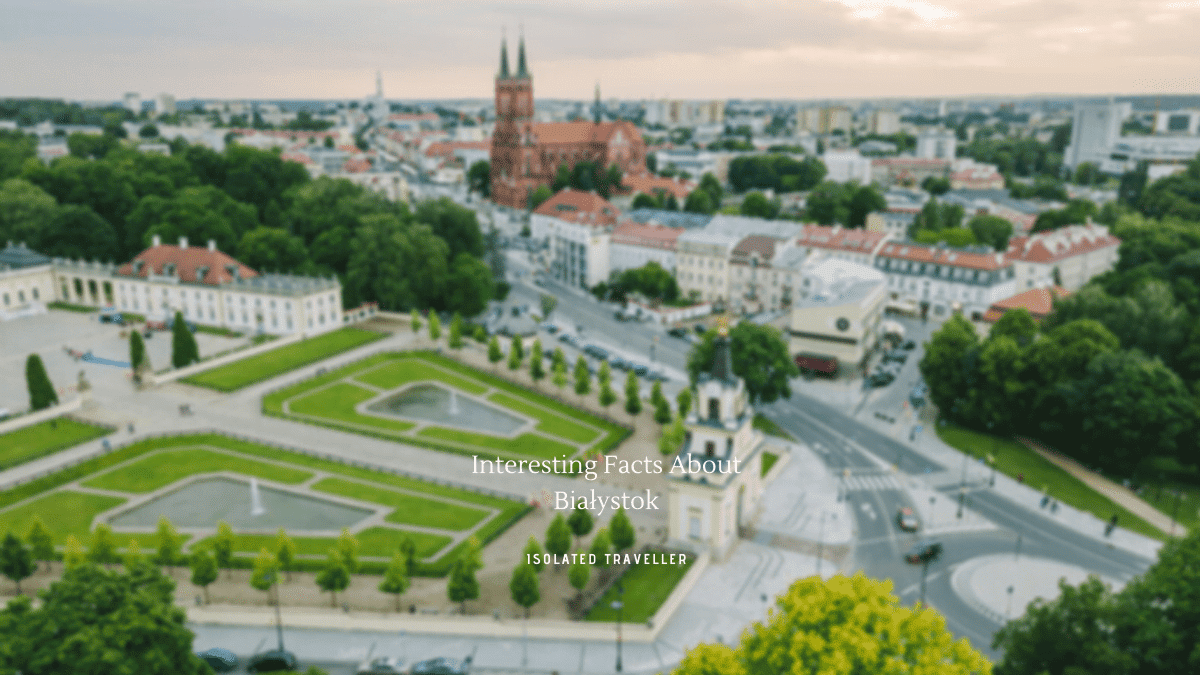
Białystok is the largest city in north-east Poland and the capital of Podlaskie Voivodeship, about 50 km from the border with Belarus. It is known for its Baroque palace, its forests and parks, its mix of cultures and faiths, and as the birthplace of the creator of Esperanto. Here are the most interesting facts about Białystok, checked and updated.
Key facts at a glance
- Country: Poland
- Region: capital of Podlaskie Voivodeship
- Population: 289,217 (end of 2025)
- Area: 102 square km
- River: Biała
- City rights: 1692
Geography and population
1. Białystok is the tenth largest city in Poland
It had 289,217 residents at the end of 2025, with about 450,000 in the metropolitan area.
2. It is the second most densely populated city in the country
Around 2,800 people live on each square kilometre, even though it ranks only thirteenth by area.
3. The name means “white slope” or “white stream”
It comes from the Biała, the small river that flows through the city.
4. It is about 200 km from Warsaw
The border with Belarus is only about 50 km to the east.
5. Almost a third of the city is green
Parks, squares and forest reserves cover about 32 per cent of its area, and forests alone cover 18 per cent, which makes it the fifth most forested city in Poland.
6. It lies in the Green Lungs of Poland
The region around it is known for its clean air, primeval forests and national parks, including Białowieża Forest, home of the European bison.
7. It is divided into 28 districts
The districts are known as osiedla.
8. People have lived here since the Stone Age
Ancient burial mounds survive in the Dojlidy district.
History
9. It was first mentioned around 1437
The land on the Biała River was granted to a nobleman by a Lithuanian duke.
10. It belonged to Lithuania for 132 years
The area was part of the Grand Duchy of Lithuania until the Union of Lublin transferred it to the Polish Crown in 1569.
11. A war hero received it as a reward
In 1661 the town was given to the commander Stefan Czarniecki for his service in the war against Sweden. It soon passed to the Branicki family through marriage.
12. It became a city in 1692
Stefan Mikołaj Branicki obtained city rights from King John III Sobieski.
13. It was known as the Versailles of Podlasie
In the 18th century Jan Klemens Branicki, one of the richest men in Poland, turned his palace and the town around it into a showpiece of French-style Baroque.
14. The first military engineering school in Poland opened here
The School of Civil and Military Engineering was founded in 1745.
15. It was Prussian, then Russian
Prussia took the city in the Third Partition of 1795. In 1807 the Treaties of Tilsit handed it to the Russian Empire, where it remained for more than a century.
16. It was called the Manchester of the North
After the Warsaw to Saint Petersburg railway arrived in 1862, Białystok became the second largest textile centre in Poland, after Łódź.
17. It was once a mostly Jewish city
In 1897 about 63 per cent of the 66,000 residents were Jewish, and in the 1930s the share was still above 40 per cent.
18. The Great Synagogue was burned in 1941
On 27 June 1941 German forces set fire to the synagogue with an estimated 2,000 Jews locked inside. A memorial stands on the site.
19. The ghetto rose in revolt in 1943
The Białystok Ghetto Uprising began on 15 August 1943. It was the second largest ghetto uprising in occupied Poland, after Warsaw. Most of the people held in the ghetto were murdered, mainly at Treblinka.
20. The war cut the population by almost half
Only 56,759 people lived in the city in 1946, compared with about 100,000 in 1936.
Landmarks
21. The Branicki Palace is the symbol of the city
The Baroque palace now houses the Medical University of Białystok. Its formal gardens cover almost 10 hectares and are open to the public.
22. The cathedral is two churches in one
A small 17th-century church stands joined to the red-brick Gothic Revival basilica built between 1900 and 1905.
23. St Roch’s Church is a monument to independence
The white modernist church on a hill, built between 1927 and 1946, was designed as a memorial to the rebirth of Poland.
24. The main street is lined with lime trees
Lipowa Street, whose name means “lime tree street”, runs from Kościuszko Square to Independence Square.
25. A priest linked to the Divine Mercy is buried here
The Sanctuary of Divine Mercy holds the tomb of Blessed Michał Sopoćko, the confessor of St Faustina Kowalska.
26. The Planty park dates from the 1930s
The 15-hectare park beside the palace was laid out between 1930 and 1938.
Culture, people and food
27. The creator of Esperanto was born here
Ludwik Zamenhof was born in Białystok in 1859. Growing up in a city where Poles, Jews, Russians, Germans and Belarusians often could not understand one another inspired him to create an international language, published in 1887.
28. A New York bread roll comes from Białystok
The bialy, a chewy roll with a dimple filled with onion, was taken to the United States by Jewish emigrants from the city. Its full name is bialystoker kuchen.
29. The last Polish president in exile was born here
Ryszard Kaczorowski, born in Białystok in 1919, led the government in exile in London until 1990.
30. It has the largest Orthodox community in Poland
About one in ten residents is an Orthodox Christian. The city is also a centre for the Lipka Tatars, a Muslim community that has lived in the region for 600 years.
31. One of the most popular beers in Poland is brewed here
Żubr, named after the European bison, comes from the Dojlidy Brewery.
32. It is the home of Żubrówka
The Polmos Białystok distillery makes the famous bison grass vodka.
33. Its football club became champion of Poland in 2024
Jagiellonia Białystok won the national title for the first time. Its stadium holds 22,500.
34. It has the largest arts institution in the north-east
The Podlasie Opera and Philharmonic opened its modern opera house in 2012.
35. It is a centre of puppet theatre
The Białystok Puppet Theatre was founded in 1953 and is one of the oldest in Poland.
Frequently asked questions
Where is Białystok?
Białystok is in north-east Poland, about 200 km from Warsaw and 50 km from the border with Belarus.
What is Białystok known for?
The Branicki Palace, its green spaces, its multicultural history, the birthplace of Esperanto creator Ludwik Zamenhof, and the bialy bread roll.
What does Białystok mean?
The name is usually translated as “white slope” or “white stream”, after the Biała River.
Is Białystok near Białowieża Forest?
Yes. Białowieża Forest, a UNESCO World Heritage Site, is about 80 km to the south-east.
How do you pronounce Białystok?
Roughly “bya-WIS-tok”.
Last updated: November 2026.