Key takeaways
- 1. The Name “Uzda” Literally Means “Bridle”
- 2. Uzda Was First Mentioned in Historical Records in 1450
- 3. It Has Changed Hands Among Some of Europe’s Most Powerful Families
- 4. The Reformation Reformer Symon Budny Worked on a Bible Here in 1574
- 5. Uzda Became Part of the Russian Empire in 1793
- 6. Its Wooden Catholic Church Was Built in 1798 and Still Stands Today
Uzda is the kind of place most travellers have never heard of. A small town in the Minsk Region of Belarus, with a population just over ten thousand, surrounded by farmland and forest. But scratch the surface and Uzda turns out to be one of the most quietly remarkable small towns in Eastern Europe — a place that has produced world-renowned scholars, hosted a 16th-century Bible publisher, and survived nearly six centuries of changing empires.
Here are ten genuinely interesting facts about Uzda that show why this little town deserves more attention than it usually gets.
1. The Name “Uzda” Literally Means “Bridle”
The town’s name comes from the Old Slavic word uzda, meaning “bridle” or “rein” — the leather strap used to control a horse. The etymology hints at the town’s historical position on important regional trade and travel routes, where horses needed handling and travellers needed to stop.
In Belarusian and Russian, the name is written Узда. In Yiddish — which mattered for centuries in a town with a significant Jewish population — it was rendered אוזדע. The Lithuanian spelling has historically appeared as Uzdan or Uzdyanka, after the river that runs through the area.
2. Uzda Was First Mentioned in Historical Records in 1450
The first written reference to Uzda dates from 1450, when it appears in the records as a country estate (Korsakov courtyard) belonging to the Korsak family in the Minsk district.
At that point, Uzda was part of the Grand Duchy of Lithuania — one of the largest states in medieval Europe, stretching from the Baltic to the Black Sea. To put that timing in perspective: 1450 is two years before Leonardo da Vinci was born, and 42 years before Columbus reached the Americas. Uzda has been on the map, in one form or another, for nearly six centuries.
3. It Has Changed Hands Among Some of Europe’s Most Powerful Families
Uzda’s ownership history reads like a Who’s Who of Polish-Lithuanian nobility. After the Korsaks held it from the mid-15th century, the estate passed through several major families from the second half of the 16th century onwards — the Kavechinskys, the Zavishas, and the Krasińskis.
Each of these families played significant roles in the politics, military and religious life of the Polish-Lithuanian Commonwealth. The Krasińskis in particular went on to become one of the most influential noble houses in Polish history, eventually owning palaces in Warsaw that still bear their name.
4. The Reformation Reformer Symon Budny Worked on a Bible Here in 1574
In 1574, the celebrated Belarusian humanist and reformer Symon Budny spent time in Uzda working on a Bible publication. Budny is one of the most important figures in the religious and intellectual history of the region — a translator, theologian and printer who produced a Belarusian-language Catechism in 1562 and went on to translate the entire Bible from the original Hebrew and Greek into Polish.
The fact that he chose Uzda as a place to work on a Bible project tells you something about the town’s status at the time. It wasn’t a backwater; it was a meaningful node in the network of Reformation-era learning in the Grand Duchy of Lithuania. Some sources indicate Budny wrote a preface to one of his books while there.
5. Uzda Became Part of the Russian Empire in 1793
For most of its early history, Uzda sat squarely within the Grand Duchy of Lithuania and, after 1569, the Polish-Lithuanian Commonwealth. That ended with the Second Partition of Poland in 1793, when imperial Russia, Prussia and Austria carved up the Commonwealth between them and Uzda was absorbed into the Russian Empire.
It would remain part of imperial Russia until the empire itself collapsed in 1917, then briefly part of the short-lived Belarusian People’s Republic before being incorporated into the Soviet Union and, finally, becoming part of independent Belarus in 1991.
6. Its Wooden Catholic Church Was Built in 1798 and Still Stands Today
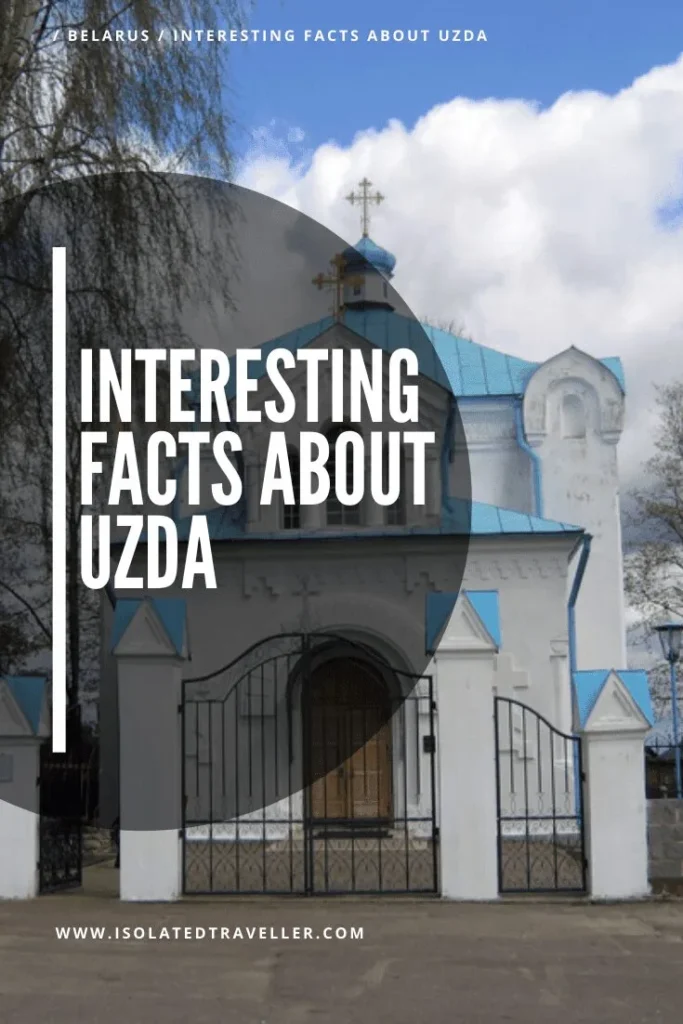
In 1798, just five years after the Russian takeover, the town’s owner Kazimierz Zawisza (Casimir Zavisha) built a wooden Catholic church dedicated to the Exaltation of the Holy Cross. Remarkably, that church still stands today, more than 225 years later — having survived the partitions of Poland, the First World War, the Soviet anti-religious campaigns of the 20th century, and the devastating Nazi occupation of the Second World War.
At the time the church was built, Uzda also had a functioning Orthodox church dedicated to Saints Peter and Paul, reflecting the mixed religious landscape of the region — Catholic, Orthodox and Jewish communities living and worshipping in the same small town.
7. Uzda Is the Birthplace of Rabbi Moshe Feinstein, One of the Most Important Jewish Legal Authorities of the 20th Century
Of all the people born in Uzda, none is more globally influential than Rabbi Moshe Feinstein, born here on 3 March 1895.
Feinstein’s father David was the rabbi of Uzda and a great-grandson of the brother of the Vilna Gaon — one of the most celebrated rabbinic figures in Jewish history. Moshe Feinstein went on to become the leading authority on Jewish law (halakha) in 20th-century North America. He emigrated to the United States in 1937, became head of the Mesivtha Tifereth Jerusalem yeshiva in New York, and spent nearly fifty years there issuing rulings on everything from medical ethics to labour disputes.
His responsa collection, Igros Moshe, remains one of the most quoted works in contemporary Orthodox Jewish literature. The New York Times obituary noted that his phone number was publicly listed and that he would personally answer calls from anyone with a question. He died in 1986 at the age of 91. A small Belarusian town produced what many consider the most important Jewish legal authority of the modern era.
8. Uzda Was Also the Birthplace of Devorah Baron — the “First Modern Hebrew Woman Writer”
The second remarkable Uzda native is Devorah Baron, born here on 4 December 1887. She is widely considered the first major woman writer in Modern Hebrew literature.
Baron’s father was the town rabbi, and unusually for the time, he allowed her to study Hebrew alongside the boys — though she had to sit in the screened-off women’s section of the synagogue. She completed high school, earned a teaching credential in 1907, and published her first stories at the age of 14 in the Hebrew newspaper Ha-Melits.
In 1910 she emigrated to Palestine. She became the literary editor of the Zionist-socialist newspaper Ha-Po’el ha-Tsa’ir, wrote around 80 short stories and a novella called Exiles, translated Flaubert’s Madame Bovary into Hebrew, and won the prestigious Bialik Prize for Literature in 1933. After 1922 she became a recluse, rarely leaving her home — but she continued writing until her death in 1956.
Two of the most influential figures in 20th-century Hebrew literature and Jewish religious law, both born in Uzda within eight years of each other. That’s a remarkable concentration of talent for a town this size.
9. The Town Sits 72 Kilometres South-West of Minsk
For anyone trying to place Uzda on a map: the town is located roughly 72 kilometres south-west of Minsk, the Belarusian capital. It sits 31 kilometres from Stoŭbcy (Stowbtsy) and 24 kilometres from Dzyarzhynsk, both of which are connected to Minsk by the M1 motorway — part of the European route E30.
Uzda itself stands at 172 metres elevation on the small Uzdyanka River, from which it likely takes its name. The town is the administrative centre of Uzda District, which became an independent district on 30 July 1966 after a brief period (from 1962) of being merged with neighbouring Dzerzhinsk district.
10. The Population Has Roughly Doubled Since 1970
Despite its small size, Uzda has seen significant population growth in the modern era. Between 1970 and 1989, its population more than doubled — from around 4,300 to 9,500. As of 2025, the population stands at 10,545 people.
That growth reflects the broader Soviet-era pattern of small Belarusian towns gaining administrative functions, light industry and infrastructure. It’s also a quiet recovery story. During the Nazi occupation of 1941–1944, around 5,600 people in the wider Uzda area were murdered, including roughly 1,740 Jews in the local ghetto. The town was liberated on 29 June 1944 by the 300th Voroshilov Partisan Brigade. For most of its history, Uzda had a substantial Jewish community — a community that was almost entirely destroyed in the Holocaust, but whose figures like Feinstein and Baron carried Uzda’s name into the wider world.
Why Uzda Is Worth Knowing About
Uzda is, by any standard measure, a small town. It doesn’t appear on most tourist itineraries. It has no famous castle, no major museum, no UNESCO designation. But the facts behind it — a name meaning “bridle,” a place where Symon Budny worked on a Bible, a birthplace of one of the most influential rabbis of modern times, the cradle of Modern Hebrew women’s literature — make it one of the most quietly significant small towns in Belarus.
For travellers interested in the deeper layers of Eastern European history, places like Uzda matter precisely because they aren’t on the standard route. They’re where the real history happens.
Frequently Asked Questions About Uzda
Where is Uzda located? Uzda is a town in the Minsk Region of central Belarus, located 72 kilometres south-west of Minsk. It serves as the administrative centre of Uzda District.
What does the name “Uzda” mean? The name Uzda comes from the Old Slavic word for “bridle” or “rein,” likely reflecting the town’s historical position on regional trade routes.
When was Uzda first mentioned in records? Uzda was first mentioned in 1450 as a country estate belonging to the Korsak family, then part of the Grand Duchy of Lithuania.
Who are the most famous people from Uzda? The two most internationally renowned figures born in Uzda are Rabbi Moshe Feinstein (1895–1986), considered the leading authority on Jewish law in 20th-century North America, and Devorah Baron (1887–1956), widely regarded as the first major woman writer in Modern Hebrew literature.
What is the population of Uzda? As of 2025, Uzda has a population of approximately 10,545 people.
When did Uzda become an independent district? Uzda became an independent district on 30 July 1966, after a brief period from 1962 during which it was merged with Dzerzhinsk district.
Is the wooden Catholic church in Uzda still standing? Yes. The wooden Catholic Church of the Exaltation of the Holy Cross, built in 1798 by Kazimierz Zawisza, has been preserved to the present day.