Kazan is the capital of the Republic of Tatarstan, a city of 1.3 million people on the Volga, about 800 kilometres east of Moscow. More than a thousand years old, it is the place where the Tatar and Russian worlds, Islam and Orthodoxy, meet. Here are 35 facts about it.
Key facts at a glance
- Country: Russia (Republic of Tatarstan)
- Founded: about 1005
- Population: about 1.3 million
- Rivers: Volga and Kazanka
- Languages: Russian and Tatar
- World Heritage Site: the Kazan Kremlin (2000)
History
- Kazan officially celebrated its 1,000th anniversary in 2005.
- It began as a frontier fortress of the Volga Bulgars.
- From 1438 it was the capital of the Khanate of Kazan, a successor state of the Golden Horde.
- Ivan the Terrible captured the city in 1552 after a long siege.
- St Basil’s Cathedral in Moscow was built to celebrate that victory.
- The icon of Our Lady of Kazan, one of the most revered in Russia, was found here in 1579.
- The rebel Pugachev burned much of the city in 1774.
- Kazan became the capital of the Tatar Autonomous Soviet Republic in 1920.
The Kremlin and landmarks
- The Kazan Kremlin is the only surviving Tatar fortress in Russia.
- Inside its walls a mosque and an Orthodox cathedral stand side by side.
- The Kul Sharif Mosque, opened in 2005, is one of the largest in Russia.
- It is named after the imam who died defending the city in 1552.
- The Annunciation Cathedral dates from the 1550s and 1560s.
- The Söyembikä Tower leans almost two metres from the vertical.
- Legend says a Tatar princess threw herself from the tower to avoid marrying Ivan the Terrible.
- The Temple of All Religions, on the outskirts, combines the architecture of many faiths in one colourful complex.
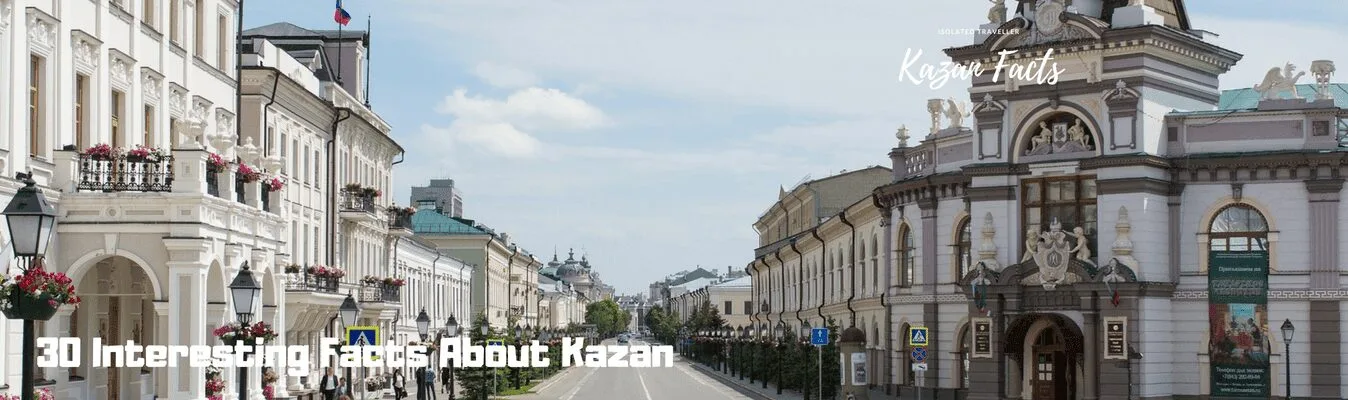
- Bauman Street is the main pedestrian street.
- The Kazan Family Centre, a registry office shaped like a giant cauldron, has a viewing platform.
Learning and culture
- Kazan University, founded in 1804, is one of the oldest in Russia.
- Leo Tolstoy studied there, and Lenin was expelled from it in 1887 for taking part in a protest.
- The mathematician Nikolai Lobachevsky, a founder of non-Euclidean geometry, was its rector.
- The chemical element ruthenium was discovered at the university in 1844.
- The great bass Feodor Chaliapin was born in Kazan in 1873.
- The writer Maxim Gorky worked in a bakery here as a young man.
- About half the population is Tatar and nearly half Russian.
- Street signs are in both Russian and Tatar.
Sport, food and modern life
- Kazan registered the title “Third Capital of Russia” as a trademark in 2009.
- It hosted the Summer Universiade in 2013 and the World Aquatics Championships in 2015.
- Six matches of the 2018 football World Cup were played at the Kazan Arena.
- The football club Rubin Kazan won the Russian league in 2008 and 2009.
- The city’s metro opened in 2005.
- Chak-chak, fried dough bound with honey, is the national sweet of Tatarstan and has its own museum.
- Echpochmak, a triangular meat and potato pie, is the classic Tatar snack.
- The summer festival of Sabantuy features wrestling, horse racing and pole climbing.
- Kazan hosted the BRICS summit in 2024.
Read more
More Russian cities: Kaliningrad, Kazan, Volgograd and Samara.
Frequently asked questions
What is Kazan famous for?
Its Kremlin, the Kul Sharif Mosque, its university and its mix of Tatar and Russian culture.
How old is Kazan?
More than 1,000 years.
Is Kazan in Europe or Asia?
In European Russia, west of the Urals.
What language is spoken in Kazan?
Russian and Tatar.
Last updated: November 2026.