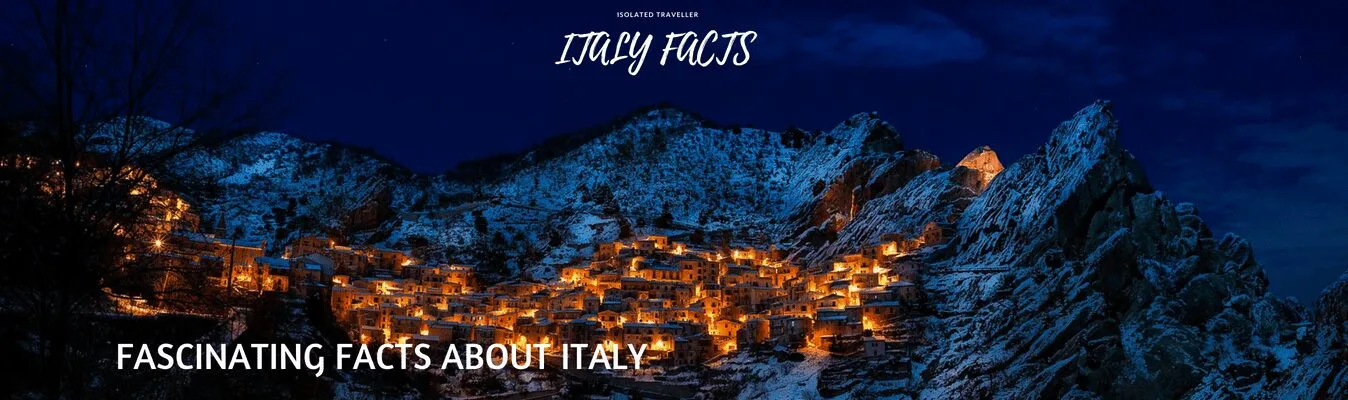
Italy has given the world the Roman Empire, the Renaissance, opera, pizza and espresso, and it has more World Heritage Sites than any other country. Yet as a unified state it is younger than the United States. Here are 85 facts about Italy, arranged by theme, covering its landscape, its long history, its people, its culture, its food and its life today.
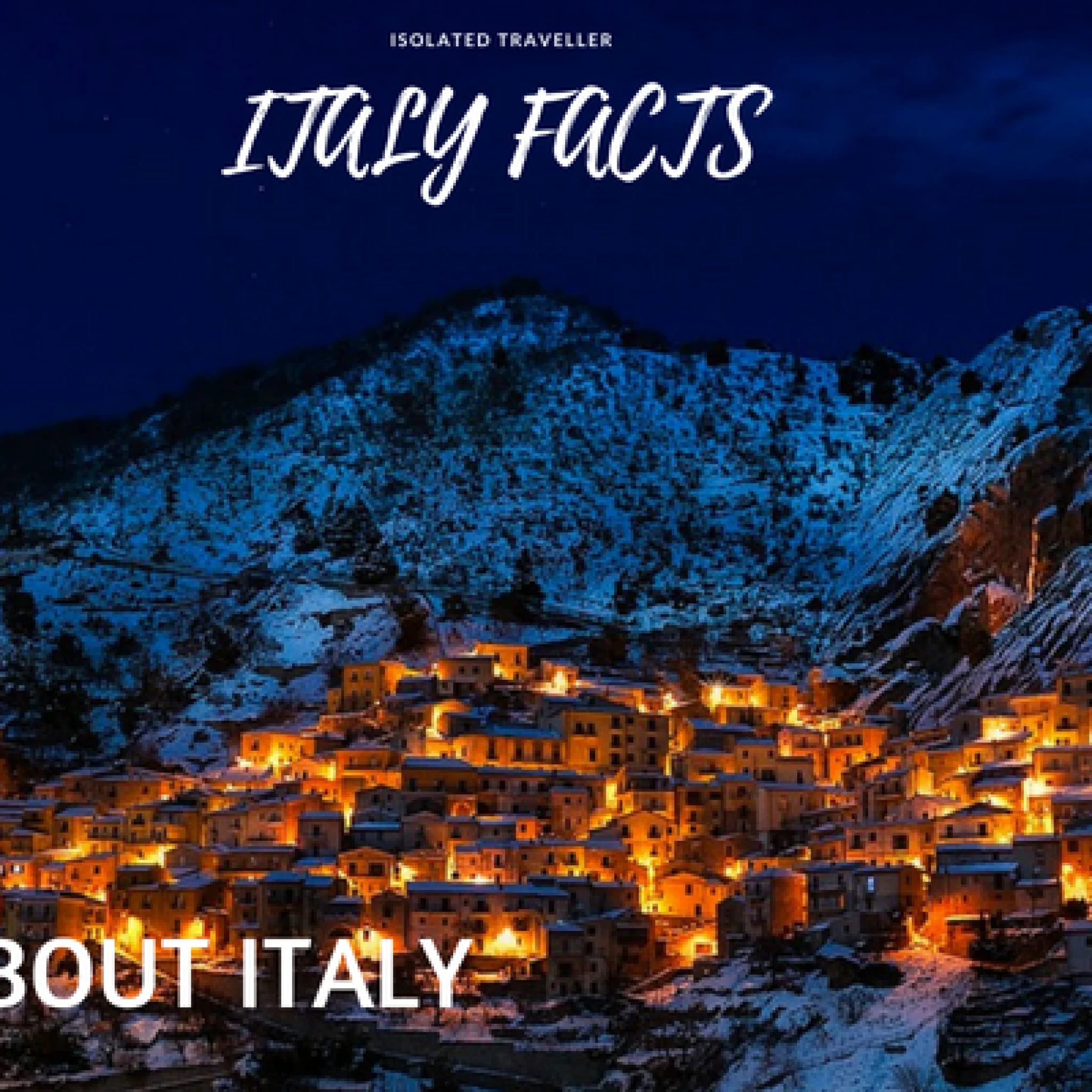
Key facts at a glance
- Capital: Rome
- Population: about 59 million
- Area: about 301,000 square kilometres
- Language: Italian
- Currency: euro
- Unified: 1861
- Republic since: 1946
Geography and nature
- Italy covers about 301,000 square kilometres, a little larger than the United Kingdom.
- The country is shaped like a boot, about 1,200 km from the Alps to the toe.
- It has roughly 7,900 km of coastline on four seas: the Ligurian, Tyrrhenian, Ionian and Adriatic.
- Mont Blanc (Monte Bianco), on the French border, is the highest point, at about 4,806 metres.
- The Po, at 652 km, is the longest river.
- Lake Garda is the largest lake.
- Sicily and Sardinia are the two largest islands in the Mediterranean.
- Italy has the only active volcanoes on mainland Europe: Vesuvius, and the Phlegraean Fields near Naples.
- Etna, in Sicily, at about 3,400 metres, is the tallest and most active volcano in Europe.
- Stromboli has been erupting almost continuously for more than 2,000 years, earning the name “Lighthouse of the Mediterranean”.
- About 40 per cent of the country is mountainous.
- Two independent states lie entirely inside Italy: Vatican City and San Marino.
- Italy shares land borders with France, Switzerland, Austria and Slovenia.
- Wolves, brown bears and lynx still live in the Italian mountains.
- The Dolomites take their name from the French geologist Déodat de Dolomieu.
History
- Rome was founded, according to tradition, on 21 April 753 BC.
- At its height in the 2nd century AD the Roman Empire ruled perhaps 60 million people.
- The Romans built about 80,000 km of paved roads.
- The Colosseum, completed in AD 80, held around 50,000 spectators.
- The eruption of Vesuvius in AD 79 buried Pompeii and Herculaneum.
- The Western Roman Empire fell in AD 476.
- The University of Bologna, founded in 1088, is the oldest in continuous operation in the world.
- The Renaissance began in Florence in the 14th and 15th centuries.
- Venice was an independent republic for more than a thousand years, until 1797.
- Modern Italy was unified only in 1861; Rome became its capital in 1871.
- The first king of united Italy was Victor Emmanuel II.
- Italy became a republic after a referendum on 2 June 1946, now a national holiday.
- Italy was a founding member of the European Economic Community in 1957, created by the Treaty of Rome.
- The Italian flag of green, white and red was first adopted in 1797.
- The national anthem, “Il Canto degli Italiani”, was written in 1847.
People and language
- Italy has a population of about 59 million.
- It has one of the oldest populations in the world, and one of the lowest birth rates in Europe.
- Standard Italian is based on the Tuscan dialect of Dante, Petrarch and Boccaccio.
- In 1861 only a small minority of Italians actually spoke Italian; most used regional languages.
- German, French, Slovene and Ladin have official status in some border regions.
- Italy is divided into 20 regions, five of which have special autonomy.
- Rome, with about 2.8 million people, is the largest city, followed by Milan and Naples.
- Sardinia is one of the world’s “Blue Zones”, where people live exceptionally long lives.
- Tens of millions of people around the world are of Italian descent, after mass emigration between 1860 and 1970.
- The most common surname in Italy is Rossi.
Art, science and culture
- Italy has 60 UNESCO World Heritage Sites, more than any other country.
- Leonardo da Vinci, Michelangelo, Raphael, Titian and Caravaggio were all Italian.
- The Leaning Tower of Pisa began to tilt during its construction in the 12th century.
- Opera was invented in Florence in about 1600.
- The piano was invented by Bartolomeo Cristofori in Florence around 1700.
- The violin took its modern form in Cremona, home of Stradivari.
- Musical terms such as allegro, forte and soprano are Italian the world over.
- Galileo Galilei, born in Pisa in 1564, is often called the father of modern science.
- Alessandro Volta invented the electric battery in 1800; the volt is named after him.
- Guglielmo Marconi sent the first radio signal across the Atlantic in 1901.
- Maria Montessori, an Italian doctor, created the Montessori method of education.
- Carlo Collodi’s “Pinocchio” (1883) is among the most translated books in the world.
- The Venice Film Festival, first held in 1932, is the oldest film festival in the world.
- The thermometer, the barometer and eyeglasses were all developed in Italy.
- Dante’s “Divine Comedy” was completed in 1321, the year of his death.
Food and drink
- Italy is usually the largest wine producer in the world.
- The pizza Margherita is said to have been named in Naples in 1889 in honour of Queen Margherita.
- The art of the Neapolitan pizza maker is on UNESCO’s list of intangible heritage.
- There are more than 350 shapes of pasta.
- Italians eat about 23 kg of pasta per person each year, more than any other nation.
- Tomatoes arrived from the Americas only in the 16th century.
- Parmigiano Reggiano must be aged for at least 12 months.
- Espresso was born in Italy; the first espresso machine was patented in Turin in 1884.
- Italians rarely drink cappuccino after late morning.
- Tiramisù was created in the Veneto in the 1960s or 1970s.
- Gelato contains less fat and less air than ordinary ice cream.
- Italy has more than 500 native grape varieties.
- Balsamic vinegar comes from Modena and Reggio Emilia.
- Nutella was created in Alba, Piedmont, in 1964.
- The Slow Food movement was founded in Italy in 1986.
Economy, sport and modern life
- Italy has the third-largest economy in the eurozone.
- Ferrari, Lamborghini, Maserati and Ducati all come from the region of Emilia-Romagna.
- Fiat was founded in Turin in 1899.
- Milan is one of the four fashion capitals of the world.
- Italy has won the football World Cup four times: 1934, 1938, 1982 and 2006.
- The Giro d’Italia cycle race was first held in 1903.
- Italy has hosted the Olympic Games in Cortina (1956), Rome (1960), Turin (2006) and Milan–Cortina (2026).
- Italy is consistently among the five most visited countries in the world.
- About 3,000 euros in coins are thrown into the Trevi Fountain every day and given to charity.
- The Vatican, inside Rome, is the smallest country in the world.
- Venice is built on 118 small islands linked by about 400 bridges.
- The Italian lira was replaced by the euro in 2002.
- Italy has one of the largest high-speed rail networks in Europe.
- The Autostrada dei Laghi, opened in 1924, was the first motorway in the world.
- The Mille Miglia road race ran from Brescia to Rome and back.
Frequently asked questions
What is Italy best known for?
Its Roman and Renaissance heritage, its art, its food and wine, its fashion and its cars.
How old is Italy as a country?
The Kingdom of Italy was proclaimed in 1861.
How many World Heritage Sites does Italy have?
60, more than any other country.
What is the capital of Italy?
Rome.
What is the highest mountain in Italy?
Mont Blanc, on the border with France.
Last updated: November 2026.