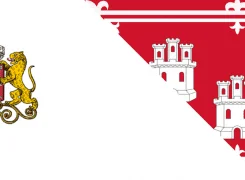
The coat of arms of Aberdeen shows three silver towers on a red shield, held up by two leopards beneath the motto “Bon Accord”. The same three towers appear on the flag of the city. Both have been symbols of Aberdeen for at least 600 years, and each part of the design has a story behind it.

Key facts at a glance
- Shield: three silver towers on a red field, inside a double border of fleurs-de-lis
- Supporters: two leopards
- Motto: Bon Accord (“Good Agreement”)
- First recorded: on city seals of the 15th century
- Registered: 25 February 1674
- Current grant: 1996, to Aberdeen City Council
The coat of arms of Aberdeen
In the language of heraldry, the arms are described as “gules, three towers triple-towered within a double tressure counterflowered argent”. In plain English, that is a red shield with three silver towers, each topped with three turrets, surrounded by a double border decorated with fleurs-de-lis. The design has appeared on the seals of the city since the 15th century, if not earlier.
In 1672 the Parliament of Scotland ordered that all coats of arms be recorded by the Lord Lyon King of Arms, and Aberdeen’s were entered in the register on 25 February 1674. They were granted again in 1976 to the City of Aberdeen District Council and in 1996 to its successor, Aberdeen City Council, which holds them today.

What the three towers mean
The towers are said to stand for three buildings on the three hills of medieval Aberdeen:
- Aberdeen Castle, on Castle Hill
- A city gate, on Port Hill
- A chapel, on St Catherine’s Hill
None of the three survives. The castle was destroyed in 1308, the gate and the chapel have long gone, and St Catherine’s Hill itself was levelled as the city grew. A single tower is often used as a shorthand for the city, and it appears in the arms of the University of Aberdeen, Robert Gordon University and Aberdeen Grammar School.
The royal tressure
The double border of fleurs-de-lis is known as the royal tressure. It comes from the royal arms of Scotland, where it surrounds the red lion, and it is a rare mark of royal favour in the arms of a town. Tradition says it was granted by Robert the Bruce in gratitude for the support of the citizens, although it may date only from the reign of James I in the 15th century.
The leopards
The shield is supported by two leopards. According to legend, they were granted by King James I to thank the burgh for helping to pay the costs of his long captivity in England. Early versions sometimes show lions instead, and there has been a long argument about whether the animals should face the viewer or be shown in profile; profile, as in the description of 1674, is now more usual.
The leopards have become a symbol of the city in their own right. Cast-iron leopards, nicknamed “Kelly’s Cats”, sit on the parapet of Union Bridge, and a long-running local magazine was called the Leopard.
The motto: Bon Accord
The motto is French for “Good Agreement”. Legend traces it to 1308, during the Wars of Scottish Independence, when the townspeople, supporters of Robert the Bruce, stormed Aberdeen Castle and killed its English garrison. “Bon Accord” is said to have been their secret password that night.
The phrase is everywhere in Aberdeen, from the Bon Accord shopping centre to streets, businesses and sports clubs, and the city has an official toast: “Happy to meet, sorry to part, happy to meet again: Bon Accord!” A town in Alberta, Canada, is named Bon Accord after the motto.
The second shield: St Nicholas
Aberdeen has a second, less familiar emblem, taken from the reverse of the old city seal. It shows St Nicholas, the patron saint of the city, praying over three children in a cauldron, a scene from the legend in which he restores to life children murdered by an innkeeper. St Nicholas was the protector of sailors, a natural patron for a seaport, and the mother church of the city, the Kirk of St Nicholas, is dedicated to him.
The flag of Aberdeen
The flag of the city is a banner of the arms: the three silver towers and the royal tressure on a red field, without the leopards or the motto. Like the arms, the design goes back to the 15th century, if not earlier. It flies from the Town House and other council buildings, and red and white, the colours of the arms, are also the colours of Aberdeen Football Club.
Frequently asked questions
What does the Aberdeen coat of arms show?
Three silver towers on a red shield, within a double border of fleurs-de-lis, supported by two leopards, with the motto “Bon Accord”.
What does Bon Accord mean?
It is French for “Good Agreement” and is the motto of Aberdeen.
Why does Aberdeen have leopards on its coat of arms?
Legend says King James I granted them in thanks for the help of the city in paying for his captivity in England.
What do the three towers on the Aberdeen flag represent?
Three buildings that stood on the three hills of the medieval town: the castle, a city gate and a chapel.
How old is the Aberdeen coat of arms?
It has been used on city seals since at least the 15th century and was formally registered in 1674.
Last updated: November 2026.