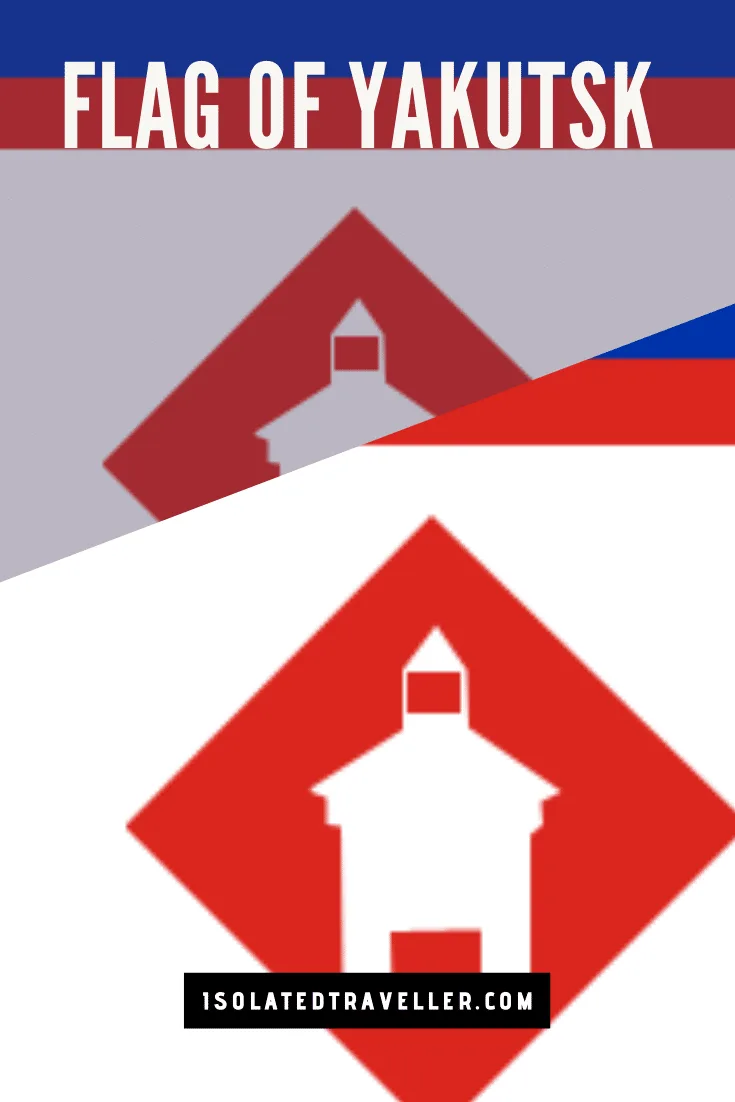
The flag of Yakutsk is the official flag of the capital of the Sakha Republic (Yakutia) in the Russian Far East. It shows a white 17th-century wooden tower inside a red diamond, set on a broad white stripe between narrower bands of blue, red and green. This guide explains the design, what each element stands for, and the city the flag represents.

Key facts at a glance
- Adopted: 20 June 1996
- Proportions: 1:2
- Design: five horizontal stripes of blue, red, white, red and green, with a red diamond containing a white tower
- City: Yakutsk, capital of the Sakha Republic, Russia
- Population of the city: 355,443 (2021 census)
Design of the flag
The flag of Yakutsk is twice as long as it is tall and is made up of five horizontal stripes of unequal width. From top to bottom they are blue, red, white, red and green. The white stripe is by far the widest, taking up ten sixteenths of the height of the flag. The blue and green stripes each take up two sixteenths, and the two red stripes one sixteenth each.
In the centre of the white stripe is a red rhombus, or diamond. Inside it, in white, is a wooden tower of the kind built in Siberia in the 17th century.
What the colours and symbols mean
- White stands for the North.
- Blue stands for the sky.
- Green stands for summer and grass.
- Red stands for life, warmth and gladness.
- The rhombus stands for the native land.
- The tower recalls the wooden fort from which the city grew.
The colours echo the flag of the Sakha Republic, which also uses light blue, white, red and green.
The tower on the flag
Yakutsk began as a Cossack fort. The original settlement, known as Lensky Ostrog, was founded on the Lena River on 25 September 1632, and the fort was moved to its present site in the Tuymaada Valley in 1642 and 1643. For centuries wooden towers from the old fortress stood in the city, and the tower became its best-known emblem. It appears on the flag as a reminder of that origin.
About Yakutsk
Yakutsk is the capital and largest city of the Sakha Republic, about 450 km south of the Arctic Circle. It lies on the western bank of the Lena River, where it is a major river port.
- It is the largest city in the world built on continuous permafrost.
- It is often described as the coldest major city on Earth. The average temperature across the year is −8.0 °C, and the record low is −64.4 °C, set in 1891.
- Summers can be hot: the record high of 38.4 °C was set on 17 July 2011. The gap of more than 100 degrees between the two records is the largest of any city.
- The temperature has never risen above freezing between 10 November and 14 March.
- The 2021 census counted 355,443 residents, and estimates have since passed 370,000.
- The economy of the region is based on mining, especially diamonds, gold and coal.
- The Melnikov Permafrost Institute, founded in 1960, studies frozen ground from a tunnel beneath the city.
- A bridge more than 3 km long is being built across the Lena, the first to link the city with the opposite bank.
Related flags
The flag of the Sakha Republic, adopted on 14 October 1992, is light blue with a white disc representing the northern sun, above narrow stripes of white, red and green. The flag of Yakutsk uses the same family of colours in a different arrangement.
Frequently asked questions
What does the flag of Yakutsk look like?
It has five horizontal stripes of blue, red, white, red and green. In the centre of the wide white stripe is a red diamond containing a white wooden tower.
When was the flag of Yakutsk adopted?
The flag was adopted on 20 June 1996.
What does the tower on the flag of Yakutsk represent?
It represents the 17th-century wooden fort, or ostrog, from which the city of Yakutsk developed.
Where is Yakutsk?
Yakutsk is in the Russian Far East, on the Lena River, about 450 km south of the Arctic Circle. It is the capital of the Sakha Republic.
Last updated: November 2026.