The Church of La Magdalena is the oldest church in Jaén, standing in the oldest quarter of the city, at the foot of the castle hill, where Roman and Moorish Jaén began. It was built on the site of a mosque, and its courtyard, with a pool shaded by orange trees, is the ablutions court of that mosque, almost unchanged. Beside it is the spring that gave the city life, and with it one of the most famous legends in Andalusia: the Lizard of La Magdalena. This guide covers the history, the legend, and what to see.
Key facts at a glance
- Location: Plaza de la Magdalena, 23004 Jaén, Spain
- Origins: a mosque of the 9th century, rebuilt in the 11th
- Church: consecrated after 1246; rebuilt in Gothic style in the early 16th century
- Highlights: the Moorish courtyard and pool; the Gothic nave
- Nearby: the Raudal de la Magdalena spring and the lizard monument
- Entry: free
History
Roman spring, Moorish mosque
The spring of La Magdalena supplied the Roman town of Aurgi. Under Muslim rule a mosque was built beside it, traditionally in the 9th century under the emir Abd al-Rahman II, and the district became the heart of the walled city.
The church
After the conquest of 1246 the mosque was consecrated as the church of St Mary Magdalene. For a time it was used as it stood. In the early 16th century the prayer hall was replaced by the present Gothic church, with four aisles and ribbed vaults, but the courtyard and the base of the minaret, now the bell tower, were kept.
What to see
The courtyard
The patio is the best-preserved piece of Islamic Jaén: a rectangular pool for ritual washing, surrounded by arcades of pointed horseshoe arches and planted with fruit trees. Roman gravestones are built into its walls.
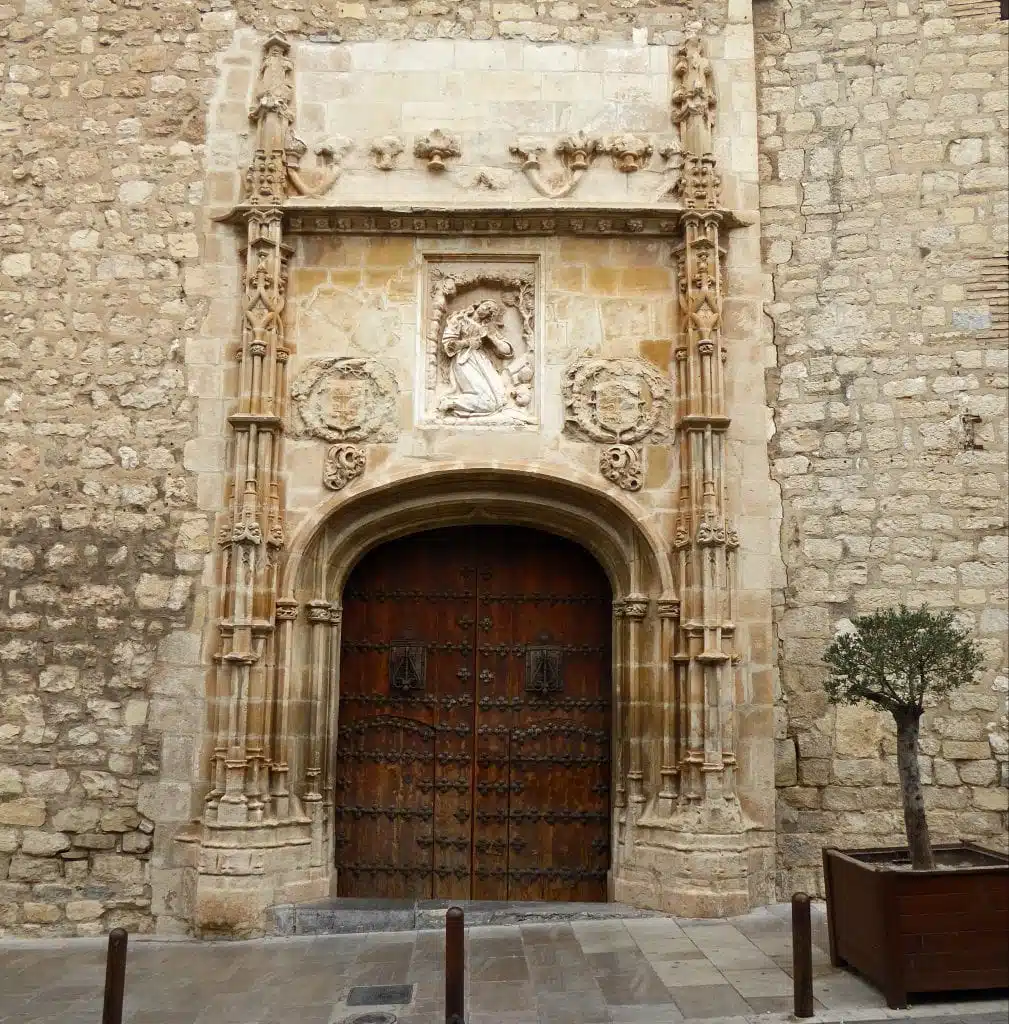
The west door
A fine doorway in the flamboyant Isabelline Gothic style, with a relief of Mary Magdalene.
The interior
Look for the altarpiece of the Calvary by Jacopo Torni, a Florentine who had worked with Michelangelo, and a much-venerated figure of Christ carried in the Holy Week processions.
The tower
The lower part is the minaret of the mosque; the upper stage was added in the 16th century.
The legend of the lizard
Long ago, the story goes, a monstrous lizard or dragon lived in the cave of the spring and devoured the sheep, and sometimes the people, who came for water. It was killed, in the best-known version, by a shepherd or a condemned prisoner, who fed it a lamb’s skin stuffed with burning tinder, or gunpowder, so that the beast burst. “May you burst like the lizard of La Malena” is still a local curse. A sculpture of the lizard stands by the fountain in the square, and the creature has become a symbol of the city.
The quarter of La Magdalena
- The Raudal, the Renaissance fountain-house of the spring, faces the church.
- The former Hospital of San Juan de Dios and the Royal Monastery of Santo Domingo, once the seat of a university and of the Inquisition, are close by.
- The Arab Baths and the Arco de San Lorenzo are ten minutes’ walk towards the centre.
- The cathedral is about 15 minutes away, and the Castle of Santa Catalina stands above.
Visiting
- The church is generally open before and after services, in the morning and early evening; it has no fixed tourist hours.
- Entry is free. Please do not walk around during Mass.
- The quarter is hilly and its lanes are narrow; it is best explored on foot.
For more on the city, read our amazing facts about Jaén.
Frequently asked questions
What is the oldest church in Jaén?
La Magdalena.
Was La Magdalena a mosque?
Yes. The courtyard and the base of the tower survive from it.
What is the legend of the lizard of Jaén?
A monster that lived in the spring of La Magdalena and was killed by being tricked into swallowing burning tinder.
Is La Magdalena free to visit?
Yes.
Last updated: November 2026.