Key takeaways
- 1. The Soviets Blew It Up on 30 May 1950
- 2. The Current Monument Was Built in Just 14 Days in 1989
- 3. The Rebuilt Crosses Are 1.8 Metres Taller Than the Original
- 4. You Can Still See Fragments of the Old Monument Below the New One
- 5. The Original Wooden Crosses Were Built Before 1649
- 6. The Legend Behind the Crosses Involves 14 Friars, Not Just Seven
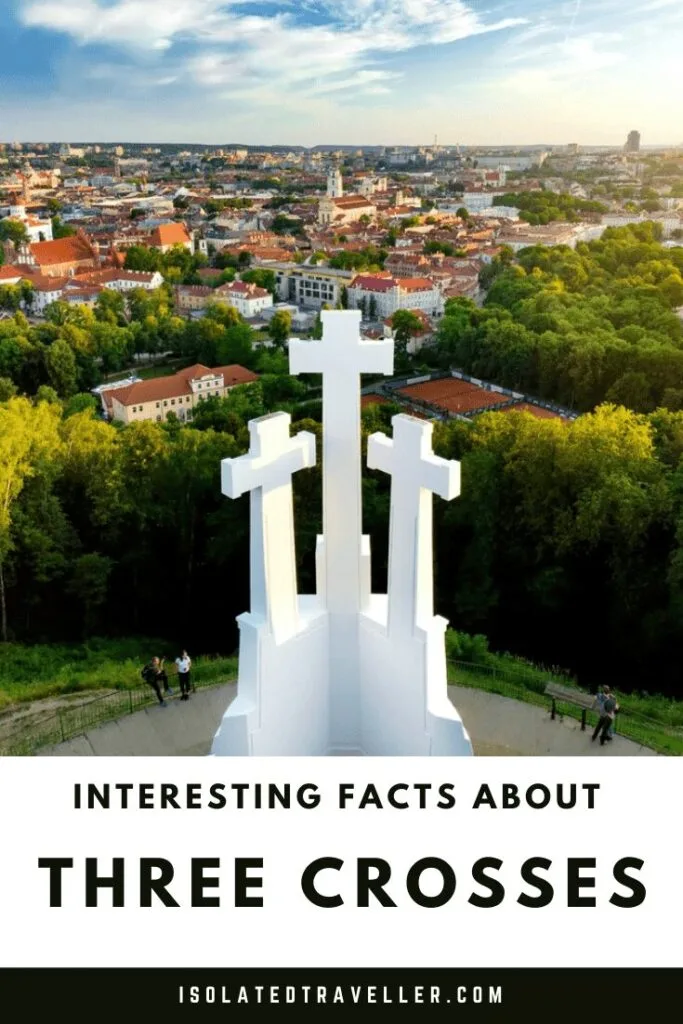
High above the rooftops of Vilnius, three stark white crosses rise from a hilltop that has been called Bald Hill, Crooked Hill and finally — for the last four centuries — the Hill of Three Crosses. The monument looks simple. The story behind it isn’t.
Here are ten genuinely interesting facts about the Three Crosses of Vilnius, the most photographed silhouette in Lithuania’s capital and one of the most quietly defiant monuments in Eastern Europe.
1. The Soviets Blew It Up on 30 May 1950
The version of the monument that stood from 1916 to 1950 — a striking white reinforced-concrete structure designed by Polish-Lithuanian sculptor Antoni Wiwulski (Antanas Vivulskis) — survived the First World War, the interwar period of Polish rule, and the Second World War. It did not survive Stalin.
On 30 May 1950, by direct order of the Soviet authorities, the monument was blown up. The destruction was deliberate and political: the crosses were one of the most visible religious symbols on the Vilnius skyline, and erasing them was part of a wider campaign to suppress Lithuanian national and Christian identity. Some of the rubble was hauled away. Larger fragments were buried on the spot.
2. The Current Monument Was Built in Just 14 Days in 1989
When the Soviet grip began to slip in the late 1980s and the Lithuanian Reform Movement gathered pace, rebuilding the Three Crosses became a national priority. The reconstruction, designed by architect Henrikas Šilgalis, took just two weeks.
The new monument was unveiled on 14 June 1989 and consecrated by Cardinal Vincentas Sladkevičius. It was dedicated as a memorial both to the victims of Stalinism and to the broader Lithuanian national revival. The fact that a country still technically under Soviet occupation rebuilt a destroyed religious monument in fourteen days, in concrete, in public, says everything about the mood of the time.
3. The Rebuilt Crosses Are 1.8 Metres Taller Than the Original
Šilgalis’s reconstruction is closely faithful to Wiwulski’s 1916 design, but with two visible changes. The new crosses sit 1.8 metres higher than the original, and the concrete is a noticeably lighter shade. Each of the three crosses now stands roughly 12 metres tall on its own.
The added height was deliberate. From the Old Town below, the monument is meant to be unmissable — and the slightly taller, paler version is more visible against the sky than its predecessor ever was.
4. You Can Still See Fragments of the Old Monument Below the New One
The Soviets thought they had destroyed the original. In fact, much of it survived underground.
When the 1989 reconstruction began, workers uncovered substantial pieces of the 1916 monument. Some were incorporated into the foundations of the new structure. Others were left visible, lying on the slope just a few metres below the current crosses, as a deliberate, silent reminder of what was done to the old monument and what was done to the country.
It’s a detail most visitors miss — but if you walk down the path on the hillside below the crosses, you can still see chunks of the original concrete on the ground.
5. The Original Wooden Crosses Were Built Before 1649
Long before the white concrete version, three wooden crosses stood on the same hill. Historical evidence places their construction sometime between 1613 and 1636 by Franciscan friars from Vilnius, with the first documented mention before 1649.
As wood does, they decayed. The crosses were rebuilt repeatedly over the following centuries, each generation maintaining the tradition until the wood finally collapsed for good in 1869. Russian imperial authorities, then in control of Vilnius, refused permission to rebuild — they understood, correctly, that the crosses had become a symbol of Lithuanian national identity.
It wasn’t until the German occupation during the First World War that permission was granted to put up a permanent structure, which is how Wiwulski’s 1916 monument came to exist.
6. The Legend Behind the Crosses Involves 14 Friars, Not Just Seven
The popular story is that seven Franciscan monks were martyred on this hill. The fuller legend, recorded in the Bychowiec Chronicle, is darker and more specific.
According to the chronicle, fourteen Franciscan friars were invited to Vilnius from Podolia by the nobleman Petras Goštautas during the reign of Grand Duke Algirdas in the 14th century. The friars began preaching Christianity and criticising the local pagan gods. While Algirdas was away fighting Moscow and Goštautas was in Tykocin, angry residents attacked the friary. Seven friars were beheaded on the hill. The other seven were nailed to crosses and thrown into the Neris river.
When Goštautas returned, he is said to have ordered the execution of 500 city residents in retaliation.
Historians treat the story as semi-legendary at best — the Bychowiec Chronicle is generally considered an unreliable source — but the cult of the martyrs spread in the 16th century, and the hill became sacred ground regardless of what actually happened there.
7. The Hill Has Had Three Different Names
The Hill of Three Crosses (Lithuanian: Trijų Kryžių kalnas) is now its formal name, but it wasn’t always called that. Older names include Bald Hill (Plikasis kalnas) and Crooked Hill (Kreivasis kalnas). Some historical sources also refer to it as Bleak Hill.
The hill sits at 165 metres elevation, with a prominence of 76 metres above the surrounding terrain, putting the monument on one of the most commanding viewpoints anywhere in central Vilnius. It’s part of Kalnai Park (literally “Hills Park”), a green space directly east of the Old Town across the Vilnia river.
8. The Monument Appeared on Lithuania’s 50 Litas Banknote
Before Lithuania adopted the euro in 2015, its national currency was the litas. The Three Crosses monument was featured on the 50 litas banknote alongside Jonas Basanavičius, one of the founding figures of modern Lithuanian nationhood.
For a country that spent much of the 20th century under occupation, putting a monument that the Soviets had blown up onto its national currency was a deliberate act of historical reclamation. The 50 litas note circulated from 1993 until the euro changeover.
9. The View From the Top Is One of the Best in Vilnius
The hill is open 24 hours a day, year-round, and entry is completely free. There are no tickets, no opening hours, no barriers.
A small observation deck at the base of the crosses offers one of the finest panoramic views of Vilnius Old Town — a sweep that takes in the spires of St. Anne’s Church, the bell tower of the Cathedral, Gediminas’ Tower on the neighbouring hill, and the red rooftops sloping down toward the Neris.
The walk up takes about 15 to 20 minutes from the river. Most visitors come at sunset, when the white concrete catches the last of the light and the Old Town glows below.
10. The Monument Is Lit Up for National Celebrations
On Lithuanian national holidays and major commemorative dates — Independence Day, Restoration of the State Day, and other key occasions — the Three Crosses are floodlit at night. The illuminated monument is visible from across the city.
It’s a small ritual, but a telling one. A monument that was destroyed by an occupying power and rebuilt in two weeks by a country pushing for independence is now lit up, every year, on the days that mark that independence. The symbolism doesn’t need explaining.
Why the Three Crosses Still Matter
A monument that has been built, destroyed and rebuilt over four centuries is rarely just a monument. The Three Crosses are a layered record of Vilnius itself: the Franciscan story, the long Polish-Lithuanian Catholic heritage, the Russian imperial refusal, the German-era reconstruction, the Soviet demolition, and the fourteen-day rebuild that helped a country reclaim itself.
That’s a lot of history standing on one quiet hill.
Frequently Asked Questions About the Three Crosses
Where are the Three Crosses in Vilnius? The Three Crosses monument stands on the Hill of Three Crosses (Trijų Kryžių kalnas) in Kalnai Park, just east of Vilnius Old Town across the Vilnia river.
Who designed the Three Crosses? The current monument was designed by architect Henrikas Šilgalis and erected in 1989. It closely follows the original 1916 design by Polish-Lithuanian sculptor Antoni Wiwulski (Antanas Vivulskis), which the Soviets demolished in 1950.
Why are there three crosses on the hill? According to legend, the crosses commemorate Franciscan friars martyred on the hill in the 14th century. Wooden crosses were first erected here by Vilnius Franciscans between 1613 and 1636.
When were the Three Crosses destroyed? The original concrete monument was blown up by Soviet authorities on 30 May 1950 as part of a campaign to suppress religious and national symbols in occupied Lithuania.
Is the Hill of Three Crosses free to visit? Yes. The monument and Kalnai Park are open 24 hours a day, year-round, with no entry fee.
How do you get to the Three Crosses? The most common route is on foot from the Old Town — cross the Vilnia river and follow the marked path up through Kalnai Park. The walk takes around 15 to 20 minutes.