Countries in Antarctica
There are no countries in Antarctica. The continent has no government, no native population and no recognised national borders. What it does have is seven countries with formal territorial claims, plus a much larger group of nations that operate research stations under the Antarctic Treaty system.
This guide covers the geography, the 1959 Antarctic Treaty, the seven territorial claims (including the three that overlap), the unclaimed sector and who actually operates on the continent today.
Antarctica at a glance
Antarctica is the fifth-largest continent, behind Asia, Africa, North America and South America. It covers roughly 14 million km², about 8.9% of Earth’s land area and 2.7% of the planet’s total surface. The Southern Ocean surrounds it on every side.
The eastern half sits significantly higher than the western half. The highest point is Vinson Massif at 4,892 metres, in the Ellsworth Mountains. The climate makes vegetation effectively impossible; the only land animals on the continent are tiny invertebrates such as mites, springtails and lice. The mammals people associate with Antarctica (seals, orcas and whales, plus penguins which are technically birds) all live in or around the surrounding seas.
There is no native human population. The only people on the continent are scientists, support staff and a much larger seasonal flow of tourists.
The Antarctic Treaty of 1959
On 1 December 1959, twelve countries signed the Antarctic Treaty in Washington DC. Contrary to a common misconception, no single country signed first; all twelve original signatories agreed simultaneously at the close of the Conference on Antarctica.
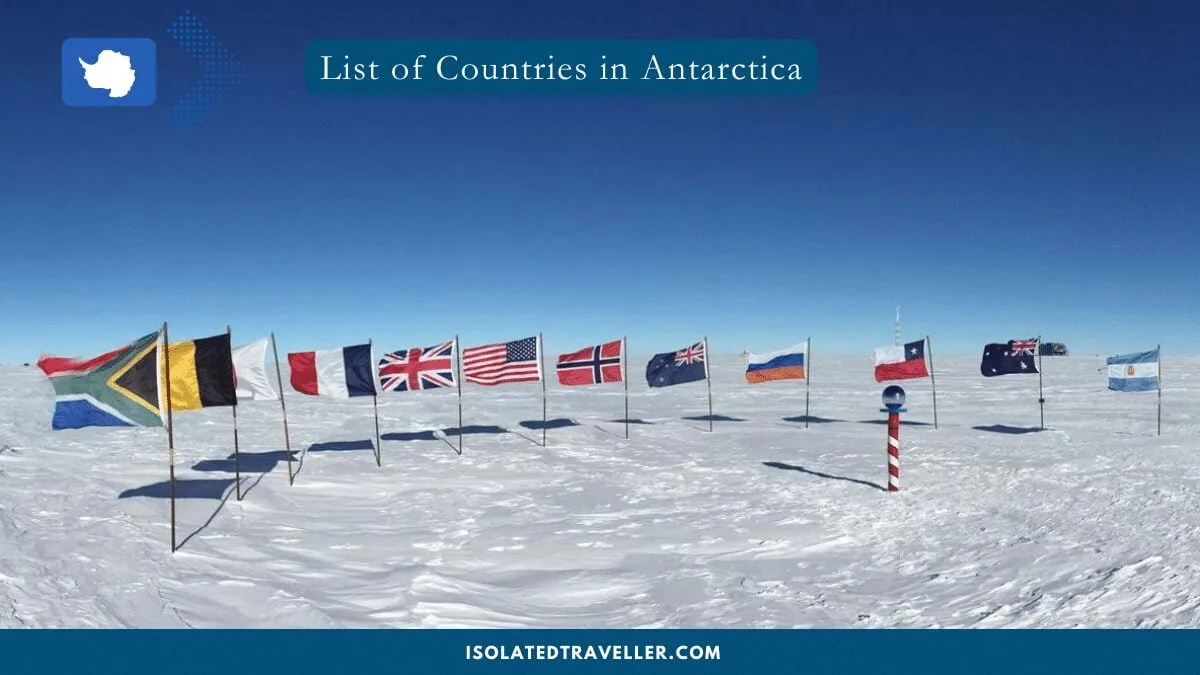
The original twelve were Argentina, Australia, Belgium, Chile, France, Japan, New Zealand, Norway, South Africa, the Soviet Union (now Russia), the United Kingdom and the United States. These were the nations whose scientists had been active in Antarctica during the International Geophysical Year of 1957-58. The Treaty entered into force on 23 June 1961.
The Treaty’s core provisions are straightforward:
- Peaceful use only. No military bases, manoeuvres, fortifications or weapons testing.
- No nuclear activity. Nuclear explosions and radioactive waste disposal are both prohibited.
- Free scientific research. Any signatory can conduct research anywhere on the continent.
- Frozen territorial claims. Existing claims are neither recognised nor denied, and no new claims can be made while the Treaty is in force.
The original Treaty did not ban mining. That came later, through the Protocol on Environmental Protection (the Madrid Protocol), signed in 1991 and in force since 1998. It prohibits all mineral resource activity until at least 2048, when it can be reviewed.
The Treaty system has grown well beyond the original twelve. There are now more than 50 parties, 29 of which hold full Consultative Party status, meaning they have a vote in the annual Antarctic Treaty Consultative Meeting.
A more detailed breakdown is available at bas.ac.uk/about/antarctica.
List of All Countries in Antarctica
Are there any countries on the continent?
No. The Antarctic Treaty effectively put country-formation on hold. There are no governments, no citizens and no passports issued for Antarctica. Even the eleven children born on the continent (all in Argentine and Chilean bases between 1978 and 1985) hold their parents’ nationality.
What does exist is a set of national territorial claims, overlapping in places and unrecognised in others, that pre-date the Treaty and remain technically on the books.
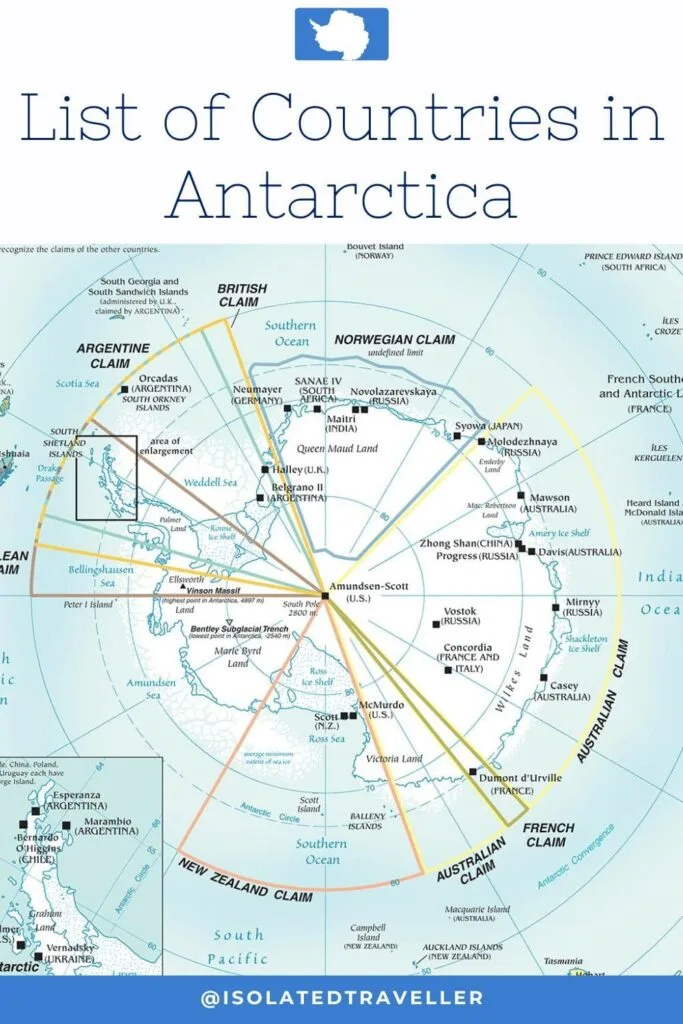
List of Antarctic Territorial claims
Seven countries claim slices of Antarctica, all defined as wedges running from the South Pole outwards. Norway uniquely holds two separate claims.
| Territory | Territory Limits | Claimant | Date |
|---|---|---|---|
| Argentine Antarctica | 25°W–74°W | Argentina | 1942 |
| Australian Antarctic Territory | 160°E–142°2′E 136°11′E–44°38′E | Australia | 1933 |
| Chilean Antarctic Territory | 53°W–90°W | Chile | 1940 |
| Adélie Land | 142°2′E–136°11′E | France | 1924 |
| Ross Dependency | 150°W–160°E | New Zealand | 1923 |
| Peter I Island | 68°50′S 90°35′W | Norway | 1929 |
| Queen Maud Land | 44°38′E–20°W | Norway | 1939 |
| British Antarctic Territory | 20°W–80°W | United Kingdom | 1908 |
Under the Treaty these claims are “frozen.” They are neither recognised nor rejected by other signatories, and most of the international community treats the continent as effectively unowned. The United States and Russia in particular have reserved the right to make claims of their own but have never done so.
Overlapping territorial claims
Three of the seven claims overlap in the Antarctic Peninsula region, which is the most accessible part of the continent and the easiest to reach from South America. The clustering is no coincidence.
| Claimants | Extent of overlap |
|---|---|
| Between Argentina & United Kingdom | 25°W–53°W |
| Between Argentia, Chile & United Kingdom | 53°W–74°W |
| Between Chile & United Kingdom | 74°W–80°W |
Argentina and Chile largely tolerate each other’s claims through the Antártica Sudamericana doctrine. The dispute with the UK is older and more pointed, and for decades it shaped diplomatic relations between London, Buenos Aires and Santiago.
Antarctic territorial Unclaimed
One large slice of Antarctica has never been claimed by any country.
| Region | Unclaimed limits |
|---|---|
| Marie Byrd Land | 90°W–150°W |
It sits between the Ross Dependency and the Chilean claim, running from the South Pole out to the coast of West Antarctica. The United States has a long operational history in the region (Byrd Station was active there in the 1950s and 60s) but has never made a formal claim, consistent with its broader position of not recognising any other country’s claims either.
Who actually operates in Antarctica today?
Claims and operations are different things. Around 70 active research stations dot the continent, run by 29 countries through the Antarctic Treaty system. About 30 of those stations stay open year-round; the rest only operate in summer when conditions allow flights and ship resupply.
The largest national programmes belong to the United States (which runs McMurdo, Amundsen-Scott South Pole and Palmer stations), followed by Argentina, Russia, Chile, the UK and Australia. China and India have both grown their presence significantly over the last two decades. South Korea, Brazil, Italy, Germany, Japan and France all run substantial bases too.
The total summer population across all stations sits at roughly 4,400 to 5,000 people. Winter contracts that to around 1,000 to 1,100, when most stations close or run with skeleton crews.
The flag of Antarctica
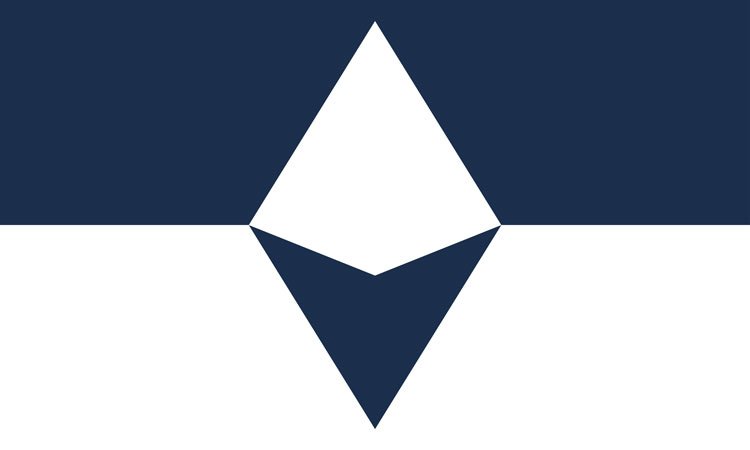
Antarctica has no official flag, because no body has the authority to adopt one on the continent’s behalf. Several unofficial flags exist, and two in particular get confused with each other.
The most widely recognised is True South, designed in 2018 by Evan Townsend while he was working as a support contractor at McMurdo Station. He sewed the first version from scrap canvas. The design uses horizontal navy and white stripes representing the long polar days and nights, with a central white peak whose shadow forms a south-pointing compass arrow. True South has since been adopted by several National Antarctic Programs and is the closest the continent has to a recognised flag.
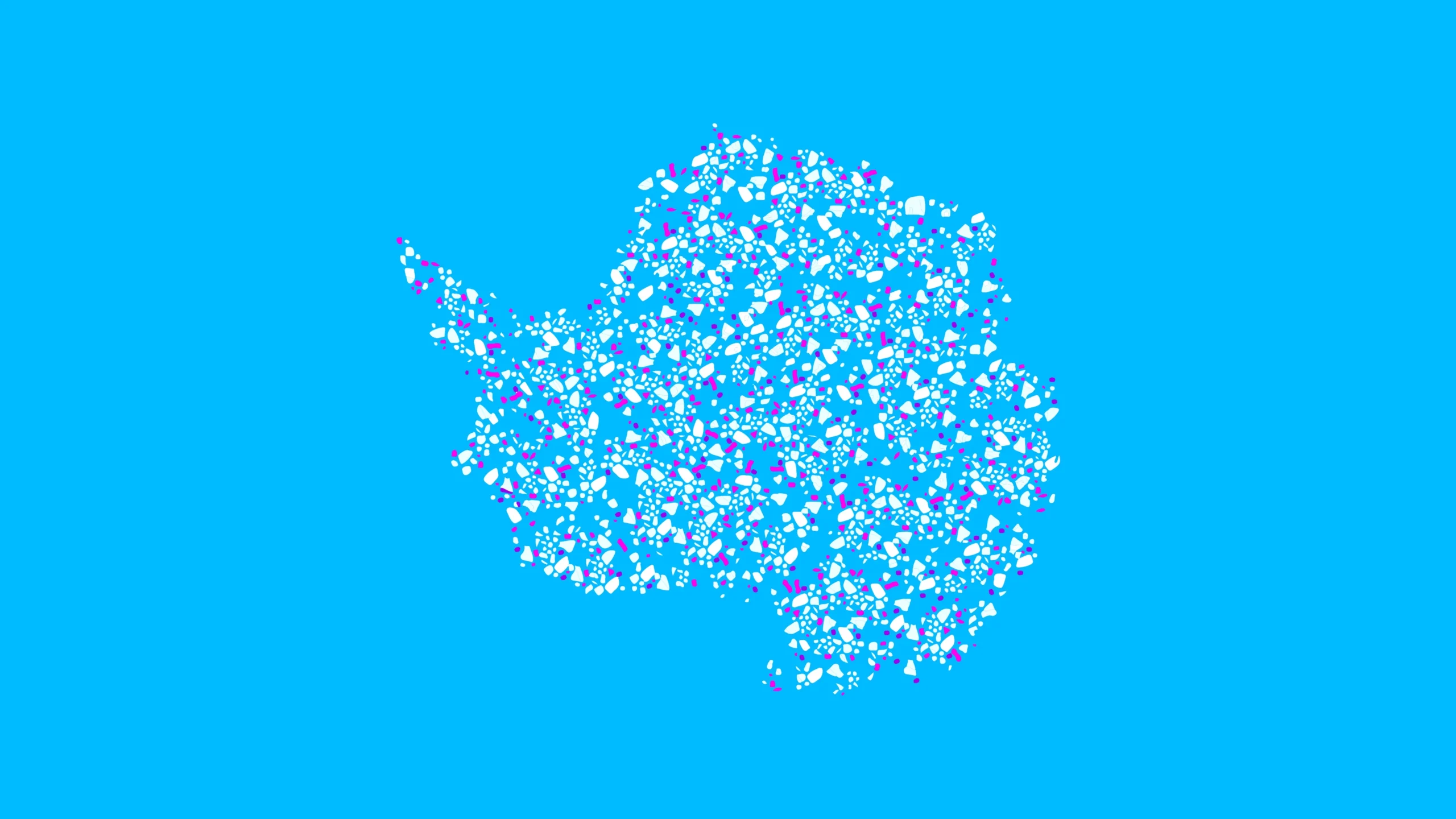
A separate flag designed by British vexillologist Graham Bartram is used as the Antarctica emoji on most platforms. It shows a simple white outline of the continent on a UN-blue background. It’s frequently mistaken for True South but is a distinct design with no broad backing among the people who actually live and work there.
Unofficial Flag of Antarctica
Other Continents Countries
- List of All Countries in South America
- List of countries in Asia
- List of All Countries in Europe
- List of All Countries in Africa
- List of All Countries in North America