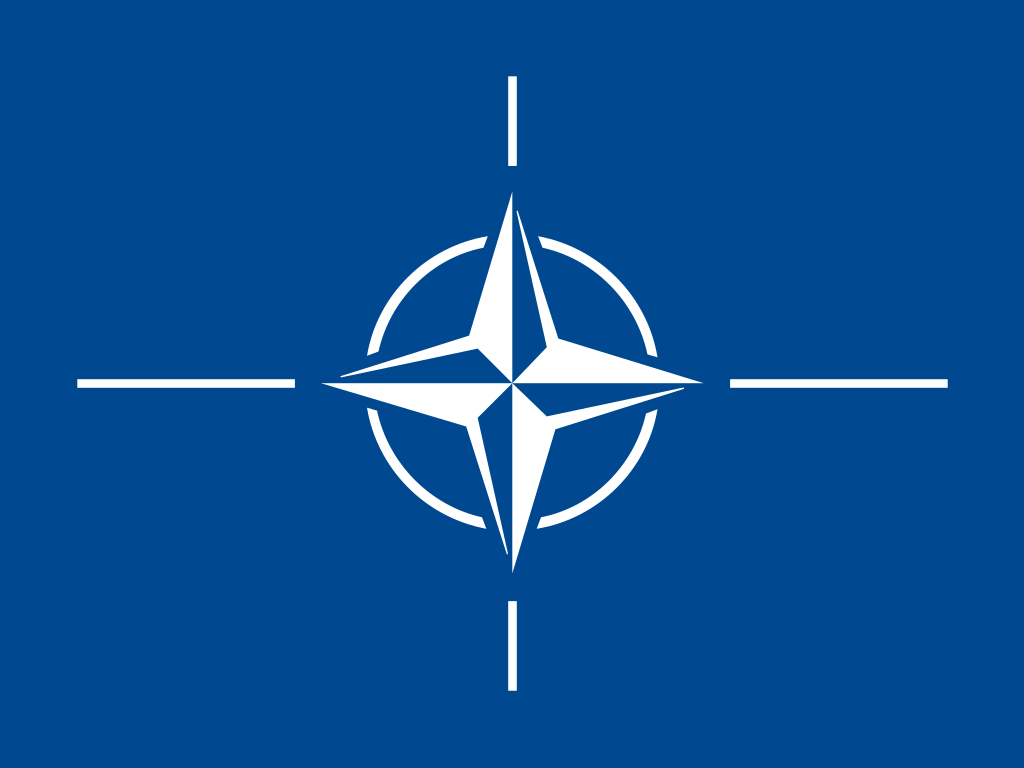
The flag of the International Atomic Energy Agency is the banner of the global nuclear watchdog established in 1957 in response to US President Eisenhower's 1953 "Atoms for Peace" speech. The emblem combining atomic symbol with olive branches captures the agency's dual mandate: promoting peaceful nuclear applications while preventing weapons proliferation.
The design
The Flag of the IAEA is a national emblem rendered in the colours and proportions defined by the country’s flag law. Its official aspect ratio is 2:3, the height-to-length ratio that fixes how the flag should be cut and flown. The colour scheme uses light blue, white, with each shade specified to particular Pantone or RGB values for official reproduction.
Colour palette
| Colour | Name | Common symbolism |
|---|---|---|
| Light blue | light blue | A nationally significant colour for this flag — see the symbolism section below for the country-specific meaning. |
| White | white | Commonly represents peace, purity, honesty or snow-capped landscapes. |
| Source | Official flag law | The country’s own statute or constitutional appendix specifies exact shades and proportions. |
Symbolism & heraldry
A light blue field bearing the IAEA emblem: the iconic atomic symbol — a central nucleus surrounded by three orbiting electrons in elliptical paths — encircled by olive branches. The atom represents the peaceful applications of nuclear science; the olive branches signal the agency's mandate to keep nuclear technology away from war.
Heraldic elements on the Flag of the IAEA — bands, charges, emblems or stars — each carry meaning agreed at the moment of the flag’s adoption. Re-readings happen across generations: a colour or a symbol that began with one meaning often picks up further layers as the country’s history unfolds.
Adoption & history
The current flag was adopted in 1958. It is credited to IAEA Secretariat (Vienna). Earlier banners flown by reflected the politics of their day; each redesign typically marked a moment of independence, regime change or constitutional reform. The current flag was chosen, debated and codified through the country’s official channels and is now protected by flag law.
Etiquette & protocol
The Flag of the IAEA should be flown with respect: never allowed to touch the ground, never used as drapery for ceremonies it was not made for, and lowered or removed at sundown unless illuminated. When flown alongside other national flags, it takes precedence on home soil and is hoisted first and lowered last. On days of national mourning, the flag is flown at half-mast in line with directives from the head of state. These conventions are common to most nations and are usually written into the flag’s founding statute.
Specifications
| Field | Value | Note |
|---|---|---|
| Country | — | |
| Continent | International | — |
| ISO alpha-2 | 2-letter code | |
| ISO alpha-3 | 3-letter code | |
| Adopted | 1958 | year of current design |
| Proportion | 2:3 | height : length |
| Colours | light blue, white | — |
| Designer | IAEA Secretariat (Vienna) | — |
| Emoji | Unicode codepoint sequence |
Did you know?
The IAEA is technically autonomous from the United Nations — it has its own statute and General Conference — though it reports to both the UN General Assembly and the Security Council. Its 2005 Nobel Peace Prize, shared with then-Director General Mohamed ElBaradei, was awarded "for their efforts to prevent nuclear energy from being used for military purposes".
About the organisation
IAEA was founded in 1957. Its headquarters are in Vienna, Austria.