Key takeaways
- The 10 Largest Cities in Slovenia
- How big are Slovenia’s cities, really?
- Ljubljana: the capital that feels like a village
- Maribor: wine, water, and the world’s oldest vine
- Celje: castle town of the powerful counts
- Kranj: the capital of the Alps
The 10 Largest Cities in Slovenia
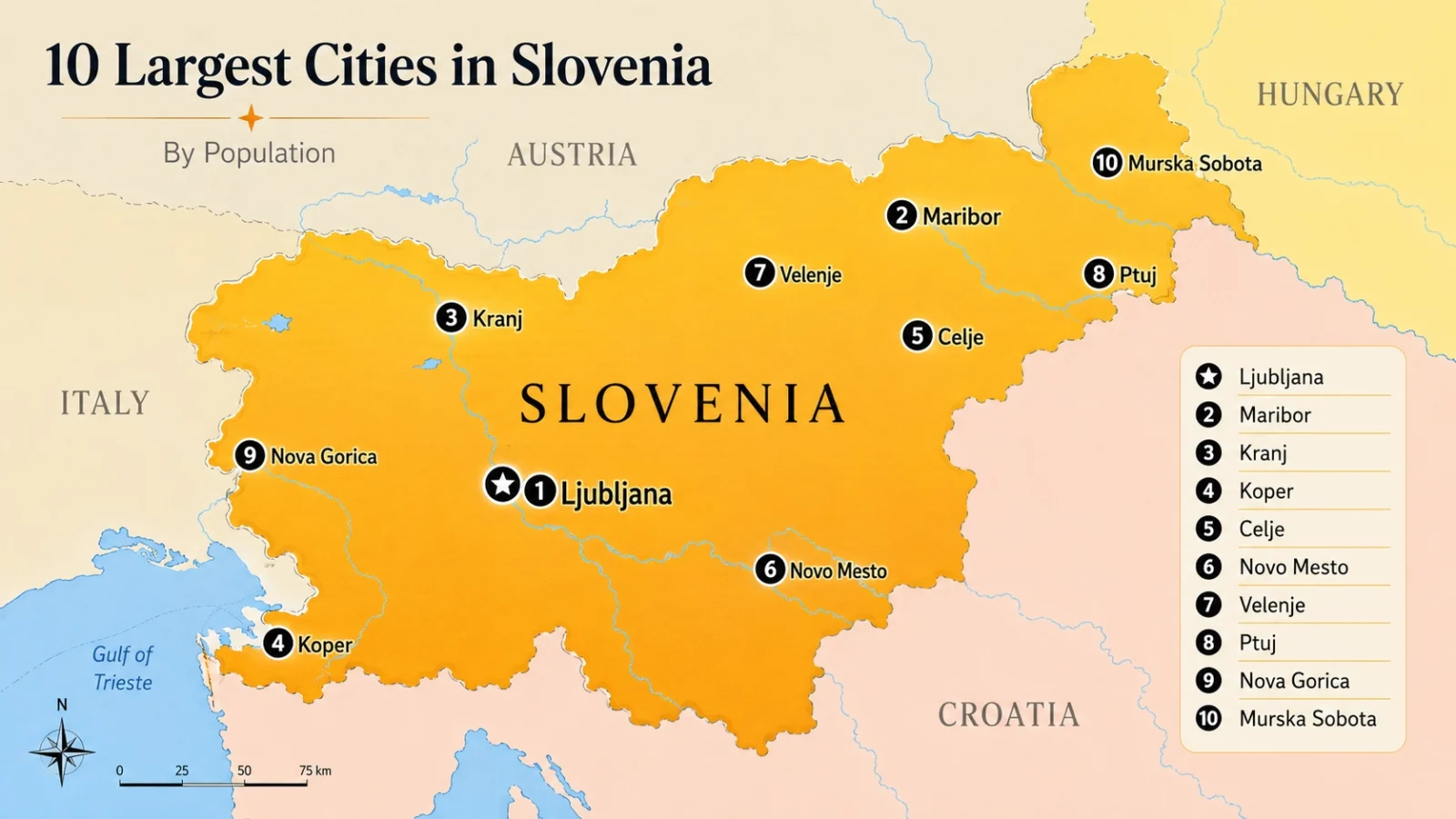
Quick answer: The largest cities in Slovenia are Ljubljana (~292,000), Maribor (~98,000), Celje (~38,000), Kranj (~38,000), Koper (~27,000), Velenje (~25,000), Novo Mesto (~24,000), Ptuj (~18,000), Trbovlje (~14,000), and Kamnik (~14,000). Ljubljana, the capital, is more than twice the size of every other Slovenian city combined at the urban core, and serves as the country’s political, cultural, and economic centre.
Slovenia packs an extraordinary amount of variety into a country smaller than New Jersey. In the space of two hours you can drive from the Adriatic coast to the foot of the Julian Alps, passing Roman ruins, medieval castles, and post-industrial towns reinventing themselves as cultural hubs along the way. Its cities are where that history becomes legible. This guide walks through the ten largest, with current population figures, what each is known for, and why it might be worth your time.
How big are Slovenia’s cities, really?
By global standards, Slovenia’s cities are small. Only Ljubljana and Maribor exceed 50,000 residents in their urban core, and the country has no metropolis in the conventional sense. What it has instead is a network of compact, walkable centres, each anchored by a castle, a river, or a town square, and each with a distinct regional identity. Population figures below reflect 2025 estimates for the urban settlement itself rather than the wider municipality, which is why some numbers differ from other sources that count surrounding villages.
| Rank | City | Population (2025 est.) | Region | Known for |
|---|---|---|---|---|
| 1 | Ljubljana | ~292,000 | Central Slovenia | Capital, riverside old town, dragon bridge |
| 2 | Maribor | ~98,000 | Drava (Lower Styria) | Wine, the world’s oldest vine, skiing |
| 3 | Celje | ~38,000 | Savinja | Medieval castle, Counts of Celje |
| 4 | Kranj | ~38,000 | Upper Carniola | “Capital of the Alps,” Prešeren legacy |
| 5 | Koper | ~27,000 | Coastal–Karst | Port city, Venetian architecture |
| 6 | Velenje | ~25,000 | Savinja–Šalek | Modern planned town, coal-mining heritage |
| 7 | Novo Mesto | ~24,000 | Southeast Slovenia | Krka River bend, pharmaceuticals |
| 8 | Ptuj | ~18,000 | Drava | Oldest town in Slovenia, Kurentovanje carnival |
| 9 | Trbovlje | ~14,000 | Central Sava | Mining history, contemporary art |
| 10 | Kamnik | ~14,000 | Upper Carniola | Alpine setting, medieval old town |
A note on the numbers: Kranj and Celje are close enough that their ranking sometimes swaps depending on the data source and whether municipality or settlement figures are used. Both sit at roughly 38,000.
Ljubljana: the capital that feels like a village
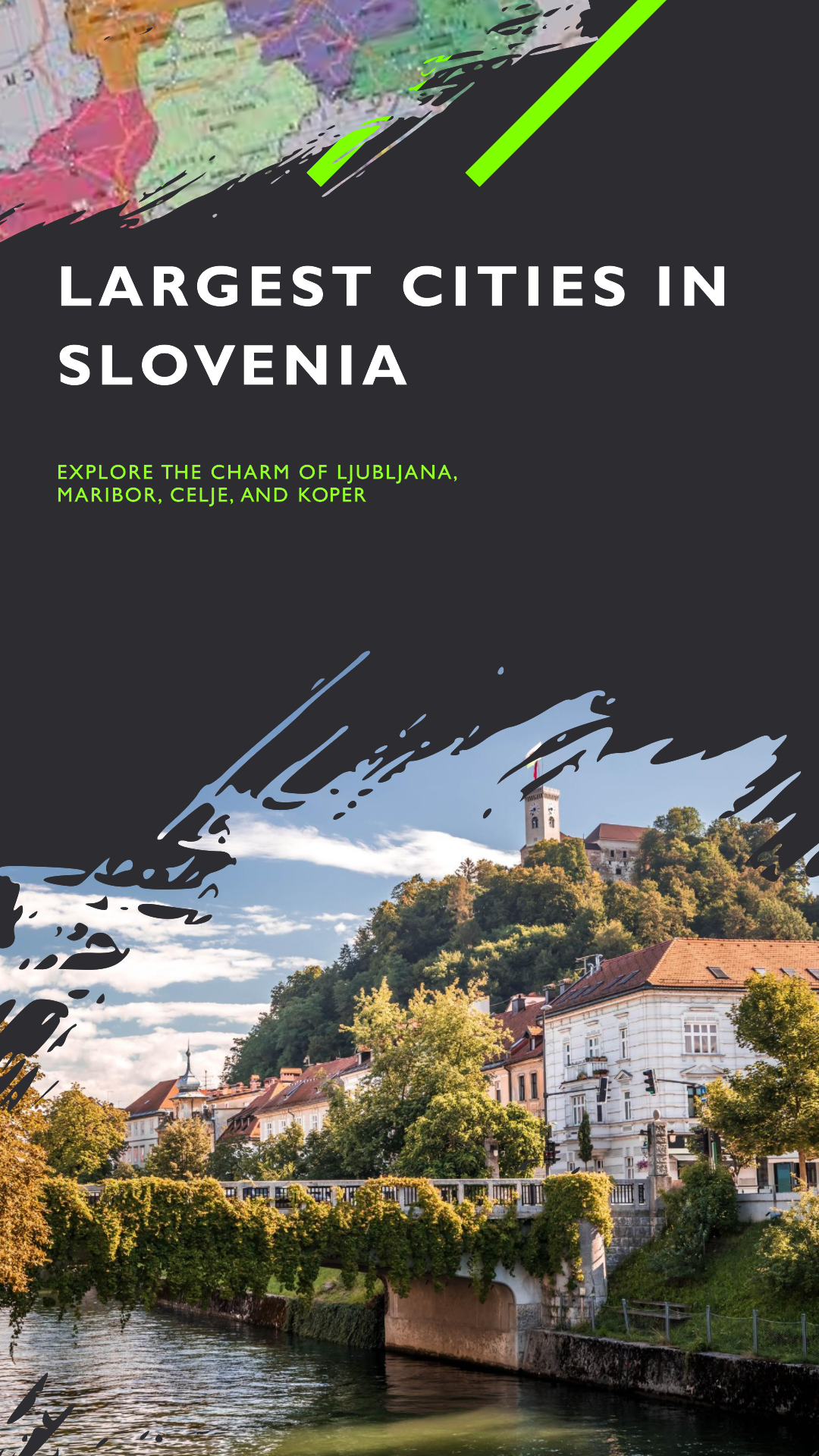
Ljubljana is the obvious starting point, and not only because it dwarfs every other Slovenian city. It manages the rare trick of being a national capital that still feels intimate. The pedestrianised centre wraps around the Ljubljanica River, lined with cafés, willow trees, and the distinctive bridges designed by architect Jože Plečnik, whose work shaped the city so thoroughly that it is now recognised by UNESCO.
The city traces its origins to the Roman settlement of Emona, founded around the first century. Its position at the crossroads of trade routes between the Mediterranean and the Alps gave it a layered history, passing through Roman, Habsburg, and Slavic influences that are still visible in its architecture. Ljubljana Castle, perched on a hill above the old town and reachable by funicular, offers the best overview of how the medieval, baroque, and modern layers fit together.
What to see: Triple Bridge, Dragon Bridge, the Central Market, Tivoli Park, and the Friday open-air food market in warm months. Ljubljana is also one of Europe’s greenest capitals, having won the European Green Capital award, and its car-free centre makes it ideal for walking.
Maribor: wine, water, and the world’s oldest vine
Maribor, Slovenia’s second city, sits on the Drava River in the wine country of Lower Styria. Its single most famous resident is not a person but a plant: the Old Vine (Stara trta), which has been growing on the façade of a riverside house for more than 400 years and is recognised as the oldest productive grapevine in the world. It still yields a small harvest each year, bottled in tiny quantities and given as a civic gift.
Beyond the vine, Maribor balances a compact medieval core with a lively university-town energy. In winter, the nearby Pohorje massif becomes a ski destination that has hosted World Cup events; in summer, the riverside Lent district hosts one of Slovenia’s largest festivals.
What to see: The Old Vine House, Maribor Cathedral, the Lent waterfront, and a day trip up to Pohorje for hiking or skiing.
Celje: castle town of the powerful counts
Celje is one of Slovenia’s oldest urban centres, with Roman roots and a medieval heyday tied to the Counts of Celje, the most powerful noble dynasty the Slovenian lands ever produced; their heraldic three stars now appear on the national coat of arms. Celje Castle, the largest fortification in the country, looms over the town from a wooded hill and rewards the climb with sweeping views over the Savinja Valley.
What to see: Celje Old Castle, the Princely Palace and its archaeological “Celeia – Roman city under the city” exhibit, and the Old Town’s pedestrian streets.
Kranj: the capital of the Alps
Just twenty minutes northwest of Ljubljana, Kranj is the fourth-largest city and the gateway to the Slovenian Alps. Its old town occupies a rocky promontory above the confluence of two rivers, honeycombed underneath by a network of WWII tunnels that are open to visitors. Kranj is closely associated with France Prešeren, Slovenia’s national poet, who spent his final years here; the central square bears his name.
What to see: The underground tunnels, Prešeren Square, Plečnik’s arcades, and the canyon of the Kokra River cutting right through the edge of the old town.
Koper: Slovenia’s window on the Adriatic
Koper is the heart of Slovenia’s short but scenic coastline and the country’s only significant cargo port. Its old town is unmistakably Venetian, a legacy of centuries under the Republic of Venice, with a central square, Tito Square, anchored by a Venetian Gothic loggia and praetorian palace. Behind the working port, the historic core rewards aimless wandering through narrow lanes that open onto sudden piazzas.
What to see: Tito Square, the Praetorian Palace, the cathedral bell tower, and nearby coastal towns Izola and Piran for contrast.
Velenje: the modernist experiment
Velenje is unusual among Slovenian cities in that it is largely a 20th-century creation, planned and built around the region’s coal-mining industry in the socialist era. That makes it a fascinating case study in mid-century urban design, complete with wide boulevards and one of the few remaining public statues of Tito. The Coal Mining Museum, set in genuine former mine shafts, is among the most distinctive museums in the country. A lake on the town’s edge has become a summer recreation hub.
What to see: The Coal Mining Museum of Slovenia, Velenje Castle, and Lake Velenje (Velenjsko jezero) in summer.
Novo Mesto: the bend in the Krka
Novo Mesto sits inside a dramatic loop of the green Krka River in southeastern Slovenia. Its old town crowds onto the riverbank, best appreciated from the water or the bridge, and the surrounding region is one of Slovenia’s most important for industry, particularly pharmaceuticals and automotive manufacturing. The area is also rich in Iron Age archaeology, earning it the nickname “the city of situlae” after the decorated bronze vessels found nearby.
What to see: The Glavni trg (main square), the riverside Breg quarter, and the Dolenjska Museum’s archaeological collection.
Ptuj: Slovenia’s oldest town
Ptuj wears its age openly. Settled in Roman times as Poetovio and first mentioned as a town in records going back nearly two millennia, it is the oldest documented town in Slovenia. A castle crowns the hill above a remarkably intact medieval and baroque centre. Ptuj is most famous nationally for Kurentovanje, a riotous pre-Lenten carnival in which costumed figures called Kurenti, draped in sheepskins and bells, parade through the streets to chase away winter.
What to see: Ptuj Castle, the old town’s monastery and tower, the historic wine cellar (one of Slovenia’s oldest), and Kurentovanje if you visit in February.
Trbovlje: from coal to contemporary art
Trbovlje, in the steep-sided Sava Valley, was for over a century the beating heart of Slovenian coal mining, and its identity is still shaped by that industrial past, including the tallest chimney in Europe. As mining wound down, the town reinvented itself as an unlikely centre for contemporary art and electronic culture, hosting festivals that draw on its raw industrial backdrop. It is also the birthplace of the avant-garde collective associated with the band Laibach.
What to see: The 360-metre chimney, the Delavski dom cultural centre, and the surrounding hiking trails through reclaimed industrial landscape.
Kamnik: alpine charm at Ljubljana’s doorstep
Kamnik closes out the list as one of Slovenia’s most picturesque small towns, set against the dramatic backdrop of the Kamnik–Savinja Alps. Its medieval old town, watched over by two castle ruins, threads along the Kamniška Bistrica River, and its cobbled centre is among the best preserved in the country. For visitors it works as both a destination in its own right and a launchpad into the surrounding mountains and the Velika Planina high pasture.
What to see: The Mali Grad chapel, the old town centre, and a cable-car trip up to Velika Planina with its iconic herders’ huts.
Frequently asked questions
What is the largest city in Slovenia? Ljubljana is by far the largest city in Slovenia, with an urban population of roughly 292,000 in 2025. It is the capital and the country’s political, economic, and cultural centre.
What is the second-largest city in Slovenia? Maribor, with around 98,000 residents, is the second-largest. It lies on the Drava River in the wine-growing region of Lower Styria and is home to the world’s oldest grapevine.
How many cities does Slovenia have? Slovenia has just over 100 settlements with formal town or city status, but only a handful exceed 20,000 people. The country’s population is around 2.1 million, so even its largest cities are modest by international standards.
What is the oldest town in Slovenia? Ptuj is the oldest documented town in Slovenia, with origins as the Roman settlement of Poetovio and a recorded history stretching back nearly 2,000 years.
Which Slovenian city is best for a coastal visit? Koper is the main city on Slovenia’s short Adriatic coastline, with strong Venetian architectural heritage. The nearby towns of Piran and Izola are also popular for their preserved seaside old towns.
Which Slovenian cities are best for skiing or mountains? Maribor (Pohorje), Kranj, and Kamnik all sit close to mountain terrain. Kranj is nicknamed the “Capital of the Alps,” and Kamnik is the gateway to the Kamnik–Savinja Alps and Velika Planina.