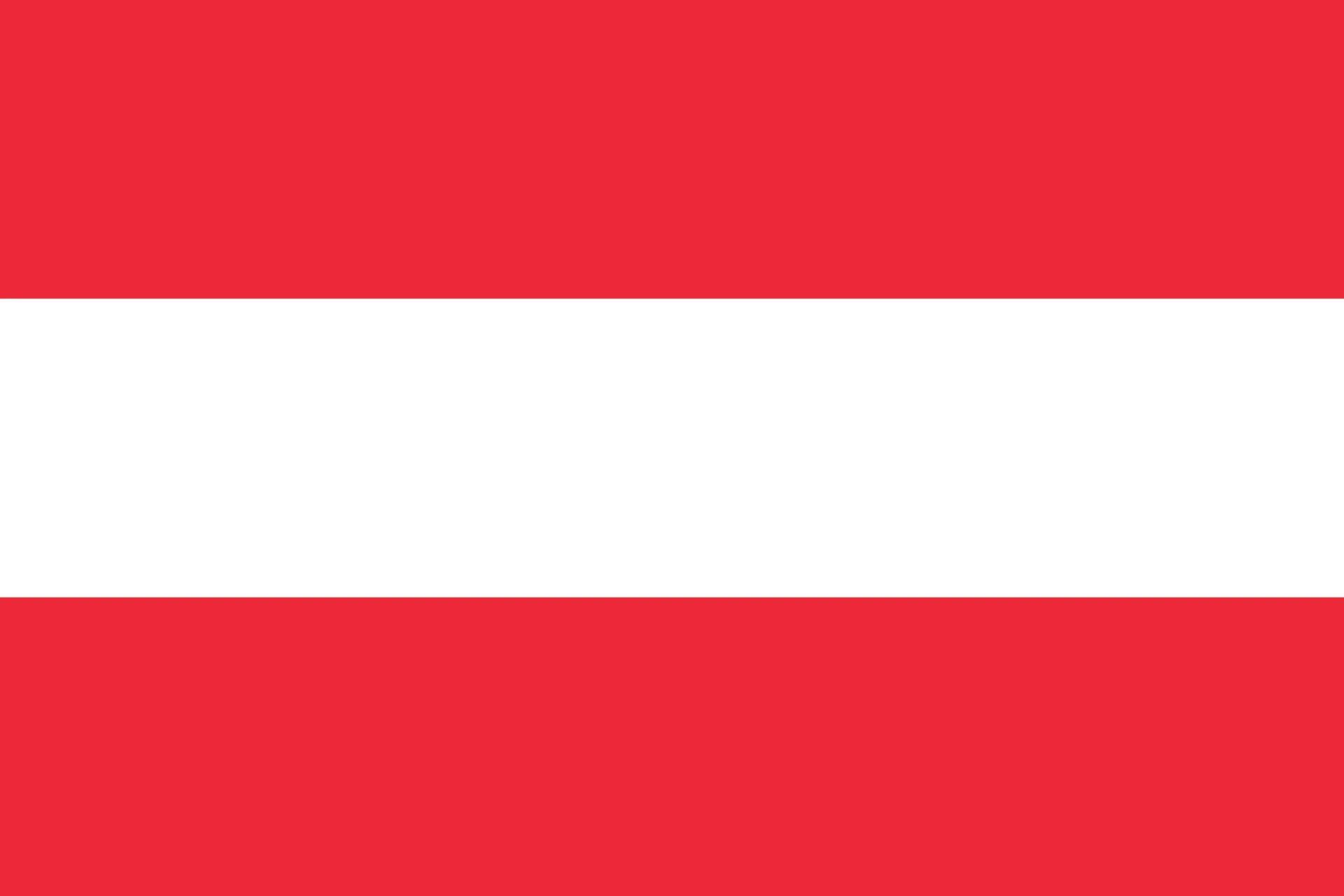
Austria's red-white-red flag is one of the oldest in the world, with documented use dating to 1230 by Duke Frederick II of Austria.
The design
The Flag of Austria is a national emblem rendered in the colours and proportions defined by the country’s flag law. Its official aspect ratio is 2:3, the height-to-length ratio that fixes how the flag should be cut and flown. The colour scheme uses Red, White, with each shade specified to particular Pantone or RGB values for official reproduction.
Colour palette
| Colour | Name | Common symbolism |
|---|---|---|
| Red | Red | Often signifies courage, sacrifice, revolution or the blood of those who fought for the nation. |
| White | White | Commonly represents peace, purity, honesty or snow-capped landscapes. |
| Source | Official flag law | The country’s own statute or constitutional appendix specifies exact shades and proportions. |
Symbolism & heraldry
Legend says Duke Leopold V's white tunic was soaked in blood during the Crusades, but a band remained white where his belt had been — inspiring the red-white-red banner.
Heraldic elements on the Flag of Austria — bands, charges, emblems or stars — each carry meaning agreed at the moment of the flag’s adoption. Re-readings happen across generations: a colour or a symbol that began with one meaning often picks up further layers as the country’s history unfolds.
Adoption & history
The current flag was adopted in 1918. Earlier banners flown by Austria reflected the politics of their day; each redesign typically marked a moment of independence, regime change or constitutional reform. The current flag was chosen, debated and codified through the country’s official channels and is now protected by flag law.
Etiquette & protocol
The Flag of Austria should be flown with respect: never allowed to touch the ground, never used as drapery for ceremonies it was not made for, and lowered or removed at sundown unless illuminated. When flown alongside other national flags, it takes precedence on home soil and is hoisted first and lowered last. On days of national mourning, the flag is flown at half-mast in line with directives from the head of state. These conventions are common to most nations and are usually written into the flag’s founding statute.
Specifications
| Field | Value | Note |
|---|---|---|
| Country | Austria | — |
| Continent | Europe | — |
| ISO alpha-2 | AT | 2-letter code |
| ISO alpha-3 | AUT | 3-letter code |
| Adopted | 1918 | year of current design |
| Proportion | 2:3 | height : length |
| Colours | Red, White | — |
| Designer | — | |
| Emoji | 🇦🇹 | Unicode codepoint sequence |
Did you know?
It is widely considered the second-oldest flag design in continuous use, after Denmark's Dannebrog.