Isolated Traveller Flags North America
MX MEX
Flag of Mexico

A national flag · vexillological catalog

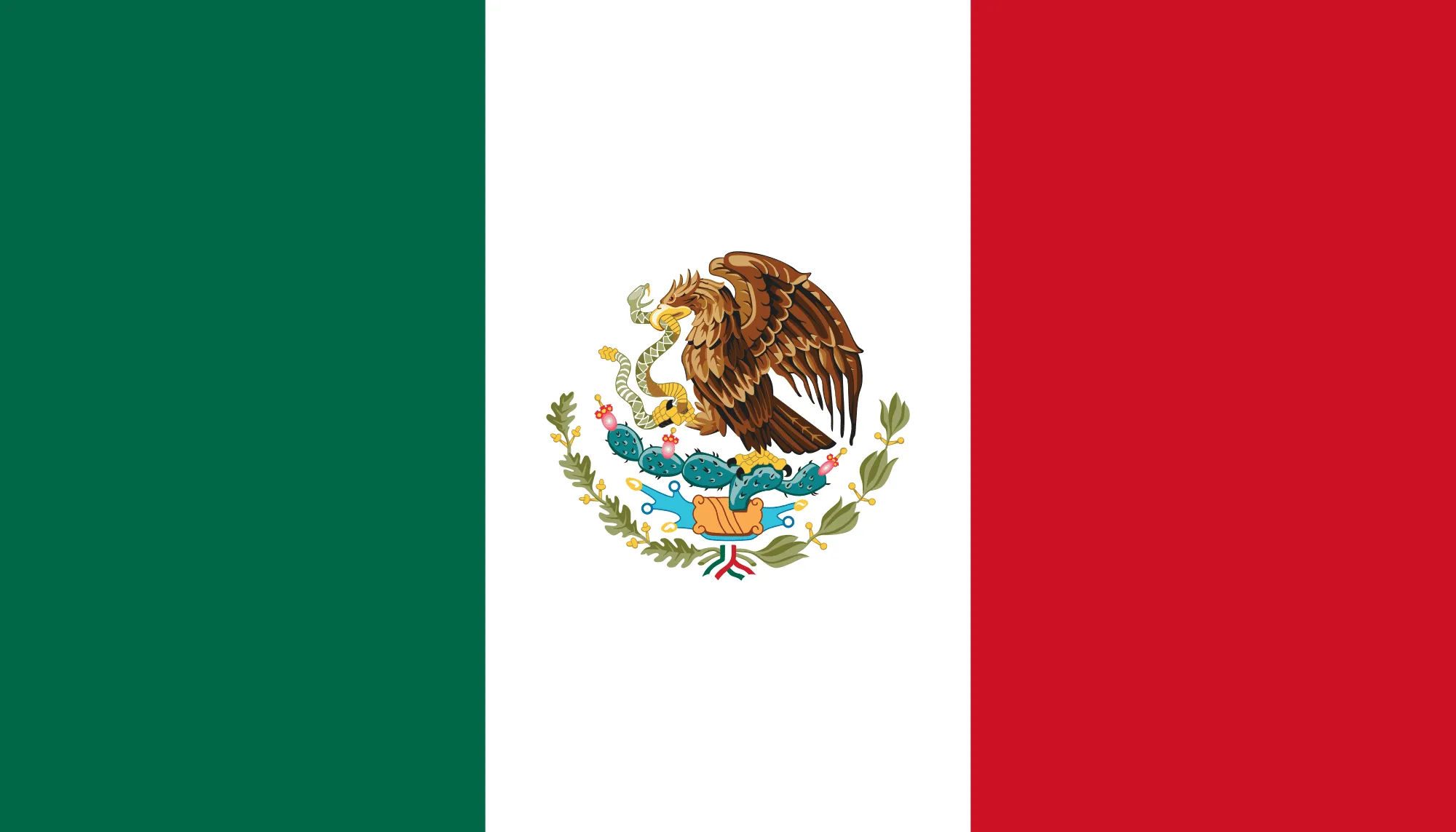
Flag of Mexico.

The flag of Mexico is a vertical tricolour of green, white and red, with the Mexican coat of arms in the centre — an eagle perched on a prickly pear cactus, holding a serpent in its talons and beak. The colours have flown over Mexico since 1821, just after independence from Spain, and the basic pattern has remained unchanged since then. The coat of arms depicts the founding myth of the Aztec capital Tenochtitlan: according to legend, the wandering Mexica people were told by their god Huitzilopochtli to settle wherever they saw an eagle on a cactus eating a snake — a sign they discovered on an island in Lake Texcoco around 1325, where they founded the city that is now Mexico City. The eagle, cactus, snake and lake island are all preserved in the modern coat of arms designed by Francisco Eppens Helguera in 1968. The flag is one of the most recognisable in the Americas, and is celebrated annually on Día de la Bandera (Flag Day) every 24 February.

Proportion
4:7
Adopted
1968
Designer
Various — coat of arms based on Aztec legend; current version designed by Francisco Eppens Helguera
Of
Mexico
01 · Symbolism
Green represents independence and hope; white purity and unity; red the blood of national heroes. The eagle eating a serpent recalls the Aztec founding myth of Tenochtitlán.
02 · Colour meanings

What each colour represents.

A breakdown of the symbolism behind each colour on the flag of Mexico.

Green

#006847

Originally represented Mexican independence from Spain. In modern interpretation, often associated with hope and the Mexican people's aspirations.

White

#FFFFFF

Originally represented the purity of the Catholic faith. In modern interpretation, often associated with unity.

Red

#CE1126

Originally represented the union between Mexicans and Spaniards living in Mexico (peninsulares and criollos). In modern interpretation, often associated with the blood of national heroes.

03 · Design & elements

How the flag is put together.

Three vertical bands of equal width — green at the hoist, white in the centre, red at the fly — with the Mexican coat of arms in the centre of the white band. Proportion 4:7.

Eagle on cactus
Depicts the Aztec founding myth of Tenochtitlan — the Mexica people, guided by the god Huitzilopochtli, founded their capital where they saw an eagle on a cactus. The eagle in the modern flag is a golden eagle (Aquila chrysaetos).
Serpent
Held in the eagle's beak and talons. In some readings, represents the triumph of good over evil; in others, an interpretation drawn from Aztec cosmology in which the eagle represents the sun god and the serpent represents earthly power.
Cactus on rock
A nopal (prickly pear cactus) growing from a rock in a lake — the specific sign the Mexica saw on the island in Lake Texcoco where they founded Tenochtitlan in 1325.
Oak and laurel
Branches of oak (left) and laurel (right) tied with a ribbon below the eagle. The oak represents strength, the laurel represents victory.
04 · Fun facts

Things to remember.

  1. 01

    The current coat of arms was designed by Francisco Eppens Helguera and adopted on 17 September 1968 — only weeks before Mexico City hosted the Olympic Games.

  2. 02

    The eagle and serpent imagery dates back to Aztec cosmology and the founding myth of Tenochtitlan, c. 1325 CE — making it one of the oldest national symbols continuously in use today.

  3. 03

    The flag's coat of arms has been redesigned eight times since 1821, but the basic Aztec eagle-and-cactus motif has been preserved throughout. Each redesign reflected the political character of the regime that commissioned it.

  4. 04

    The Italian and Mexican flags are very similar — both vertical green-white-red tricolours — but Italy's lacks any central emblem. The shades of red and green also differ, with Mexico's being darker.

  5. 05

    Mexico's Flag Day (Día de la Bandera) is celebrated on 24 February, marking the date in 1821 when the Plan of Iguala — which proposed the green-white-red tricolour — was first proclaimed.

  6. 06

    Showing only certain sides of the eagle (such as the back of the eagle) is reserved by law for the Mexican president; civilian flags must show the eagle's full profile.

05 · History

How it came to be.

The current colours date from the Plan of Iguala, proclaimed by Agustín de Iturbide on 24 February 1821 during the final stages of Mexico's war of independence from Spain. The first national flag with these colours was used from September 1821 with an Aztec eagle perched on a cactus, but without a snake. Later versions added the snake and rearranged the elements. The current version of the coat of arms — with the eagle in profile, the snake in its beak, and the Aztec rock-on-water at the base — was designed by Francisco Eppens Helguera and adopted on 17 September 1968.

03 · About

On the design.

Mexico's flag features the national coat of arms — a golden eagle perched on a prickly pear cactus, devouring a snake — at the centre of a green-white-red tricolour.

The design

The Flag of Mexico is a national emblem rendered in the colours and proportions defined by the country’s flag law. Its official aspect ratio is 4:7, the height-to-length ratio that fixes how the flag should be cut and flown. The colour scheme uses Green, White, Red, with each shade specified to particular Pantone or RGB values for official reproduction.

Colour palette

Colour Name Common symbolism
Green Green Tends to evoke land, agriculture, hope, Islam or the natural environment.
White White Commonly represents peace, purity, honesty or snow-capped landscapes.
Red Red Often signifies courage, sacrifice, revolution or the blood of those who fought for the nation.
Source Official flag law The country’s own statute or constitutional appendix specifies exact shades and proportions.

Symbolism & heraldry

Green represents independence and hope; white purity and unity; red the blood of national heroes. The eagle eating a serpent recalls the Aztec founding myth of Tenochtitlán.

Heraldic elements on the Flag of Mexico — bands, charges, emblems or stars — each carry meaning agreed at the moment of the flag’s adoption. Re-readings happen across generations: a colour or a symbol that began with one meaning often picks up further layers as the country’s history unfolds.

Adoption & history

The current flag was adopted in 1968. Earlier banners flown by Mexico reflected the politics of their day; each redesign typically marked a moment of independence, regime change or constitutional reform. The current flag was chosen, debated and codified through the country’s official channels and is now protected by flag law.

Etiquette & protocol

The Flag of Mexico should be flown with respect: never allowed to touch the ground, never used as drapery for ceremonies it was not made for, and lowered or removed at sundown unless illuminated. When flown alongside other national flags, it takes precedence on home soil and is hoisted first and lowered last. On days of national mourning, the flag is flown at half-mast in line with directives from the head of state. These conventions are common to most nations and are usually written into the flag’s founding statute.

Specifications

Field Value Note
Country Mexico
Continent North America
ISO alpha-2 MX 2-letter code
ISO alpha-3 MEX 3-letter code
Adopted 1968 year of current design
Proportion 4:7 height : length
Colours Green, White, Red
Designer
Emoji 🇲🇽 Unicode codepoint sequence

Did you know?

The eagle-and-snake image is taken from the Aztec founding legend of Tenochtitlán, where Mexico City stands today.

Frequently asked questions

What do the symbols on the Mexican flag represent?

The eagle perched on a cactus eating a snake depicts the founding myth of the Aztec capital Tenochtitlan. According to legend, the wandering Mexica people were told by their god Huitzilopochtli to settle wherever they saw an eagle on a cactus eating a snake; they found this sign on an island in Lake Texcoco around 1325 and founded the city that is now Mexico City. The oak branch represents strength, the laurel represents victory.

What is the difference between the Mexican and Italian flags?

Both are vertical green-white-red tricolours, but Mexico's flag has the elaborate Mexican coat of arms (an eagle on a cactus eating a snake) in the centre, while Italy's is a plain tricolour with no emblem. The shades of green and red also differ — Mexico's green is darker and the red is more crimson, and Mexico's flag has a slightly narrower 4:7 ratio compared to Italy's 2:3.

When was the Mexican flag adopted?

The green-white-red colour scheme was adopted in 1821 with the Plan of Iguala. The current version of the coat of arms — with the eagle in profile, the snake in its beak, and the rock-on-water base — was designed by Francisco Eppens Helguera and officially adopted on 17 September 1968. The basic flag has been in continuous use, with only minor changes to the coat of arms, for over 200 years.

Why does the Mexican flag have an eagle eating a snake?

The image depicts the founding myth of Tenochtitlan, the Aztec capital that became modern Mexico City. According to Aztec tradition, the wandering Mexica people were told by their god Huitzilopochtli to build their city wherever they saw an eagle perched on a prickly pear cactus, holding a snake in its mouth. They saw this sign on a small island in Lake Texcoco around 1325, and founded their city on the spot.

Which country does the Flag of Mexico represent?

The Flag of Mexico is the national flag of Mexico.

When was the Flag of Mexico adopted?

The Flag of Mexico was adopted in 1968 — about 58 years old.

What is the proportion of the Flag of Mexico?

The Flag of Mexico has an official proportion (height-to-width ratio) of 4:7.

Who designed the Flag of Mexico?

The Flag of Mexico was designed by Various — coat of arms based on Aztec legend; current version designed by Francisco Eppens Helguera.

04 · Country at a glance

Mexico — in brief.

Quick reference data on Mexico, the country this flag represents.

Capital
Mexico City
Continent
North America
Sub-region
Central America
Population
129M
Area
1,964,375 km²
Languages
Spanish
Currency
Mexican Peso (MXN)
Government
Federal presidential republic
Flag age
about 58 years old
Dispatch 14 · MAY · 26

A small thing, worth noting.

The eagle-and-snake image is taken from the Aztec founding legend of Tenochtitlán, where Mexico City stands today.

— filed from the catalog