Key takeaways
- 1. You’re probably pronouncing it wrong
- 2. The name comes from French-Canadian fur trappers
- 3. Boise’s Capitol building is the only one in the US heated by geothermal energy
- 4. Boise has one of the largest geothermal heating networks in the world
- 5. The Moore-Cunningham mansion was the first US home heated by natural hot water
- 6. Boise has the largest Basque community outside the Basque Country itself
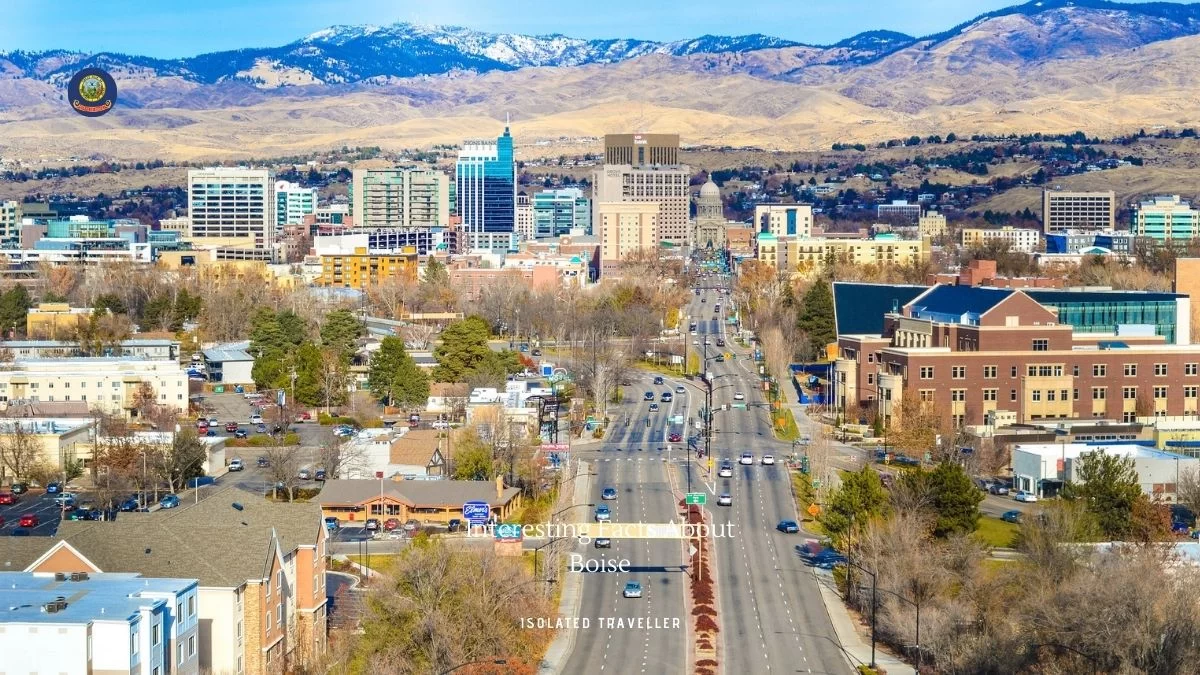
People tend to file Boise under “somewhere in Idaho that grows potatoes” and leave it at that. It’s a wildly underrated city, and once you start looking at what actually makes it tick, it gets strange quickly — in the best way. There’s an underground hot-spring system that heats the State Capitol. There’s a Basque community so large it has its own cultural block downtown. There’s a football pitch that’s bright blue. There’s the only Anne Frank memorial in the United States.
Whether you’re planning a visit, thinking about moving here, or already living in Boise and looking for fresh material for trivia night, here are 20+ interesting facts about the city — including a few you probably haven’t heard before.
1. You’re probably pronouncing it wrong
Let’s get this one out of the way first. Most people say “BOY-zee” with a Z sound at the end. Locals say “BOY-see” with a soft S. If you want to sound like you’ve been here before, that’s the one to use. Boiseans will not correct you — they’re too polite — but they will notice.
2. The name comes from French-Canadian fur trappers
The name itself comes from French-Canadian fur trappers in the early 1800s. Crossing the dry, treeless plains of southern Idaho, they reportedly came over a ridge, saw the cottonwoods lining the Boise River, and shouted “Les bois! Les bois!” (the woods, the woods). Whether or not that story is literally true, the name stuck, and so did the nickname — Boise is still called the City of Trees, and there are more than 100,000 trees within the city limits.
3. Boise’s Capitol building is the only one in the US heated by geothermal energy
This is probably the most unexpected thing about the city, and it’s one of those facts that genuinely stops people. The Idaho State Capitol building in downtown Boise is the only state capitol in the entire country heated by geothermal water. The hot water is pumped from a natural underground reservoir roughly 3,000 feet below the surface, piped into the building, used to heat it, and then piped back underground in a closed loop to be naturally reheated.
The system has been running on the Capitol since 1982. But Boise’s relationship with geothermal heating goes back much further — settlers were already piping hot water from underground springs into Victorian homes on Warm Springs Avenue in the 1890s.
4. Boise has one of the largest geothermal heating networks in the world
The Capitol is only the start of it. There are more than 20 miles of geothermal pipeline running under downtown Boise today, heating over 6 million square feet of building space — roughly a third of the entire downtown. Buildings on the network include City Hall, the Boise State University campus, the Treasure Valley YMCA, the public library, and dozens of restaurants, offices, and homes.
The water comes out of the ground at around 177°F (about 80°C). Boise was the first city in the United States to use district geothermal heating, and the city still saves thousands of tons of carbon emissions every year as a result — equivalent to taking around 2,000 petrol cars off the road. There’s even a charming local legend that the original 1890s wooden water pipe under Warm Springs Avenue hasn’t rotted because the water never stops flowing through it.
5. The Moore-Cunningham mansion was the first US home heated by natural hot water
Built in 1892 on Warm Springs Avenue, the Moore-Cunningham mansion holds a quiet claim to history as the first private home in the United States to be heated by natural geothermal water. The street it sits on was specifically named for the hot springs that made the whole geothermal system possible. Several of those original Victorian mansions still stand, still heated the same way, and lived in by people who probably get tired of explaining their utility bills to visitors.
6. Boise has the largest Basque community outside the Basque Country itself
This is the city’s other genuinely surprising fact. Boise is home to the largest Basque community in the United States, and proportionally one of the largest Basque populations anywhere outside the Basque Country in Spain and France. Basque shepherds began arriving in southern Idaho in the late 1800s to work the high desert sheep ranges, and over the next century the community grew, put down roots, and held on to its language and traditions in a way few other diaspora communities have managed.
7. Downtown has a dedicated Basque Block
Downtown Boise has a whole stretch called the Basque Block, just one street long but packed with substance. You’ll find the Basque Museum and Cultural Center (the only Basque museum in North America), traditional restaurants like Bar Gernika, a Basque boarding house preserved as a museum, and pelota courts. Walk down it on a summer evening and you’ll hear Euskara (the Basque language) being spoken between tables.
8. Jaialdi is one of the largest Basque festivals in the world
Every five years, the city hosts Jaialdi, one of the largest Basque cultural festivals on the planet. It draws tens of thousands of visitors from across the global Basque diaspora — people fly in from Spain, France, Argentina, Chile, and Australia for it. The next one is in 2025 (it was postponed from 2020 because of the pandemic), and if you can get a flight, it’s worth the trip.
9. Boise State University’s football field is bright blue
This is the most photographed thing in Boise, and most visitors don’t quite believe it until they see it in person. The football field at Boise State University, known as “The Blue” (officially Albertsons Stadium), has been bright blue since 1986. It was the first non-green football field in the country, and for decades it was the only one. Now there are a handful of imitators, but the Boise State blue field came first and is still the most distinctive.
There’s a local joke that visiting birds occasionally mistake it for a lake and crash-land on it. That’s almost certainly apocryphal, but the field really does look striking, especially from the air.
10. Boise is home to the only Anne Frank memorial in the United States
This one surprises almost everyone. The Idaho Anne Frank Human Rights Memorial, located near the Boise Public Library on the Greenbelt, is the only Anne Frank memorial anywhere in the United States. The 0.81-acre educational park opened in 2002 and centres on a life-size bronze statue of Anne Frank looking out an imaginary window from her family’s hiding place.
The site also includes a 180-foot quote wall inscribed with words from humanitarians across history, an amphitheatre used for events and education, and — remarkably — a sapling grown from the original chestnut tree that stood outside Anne Frank’s attic hideout in Amsterdam. The memorial is maintained by the Wassmuth Center for Human Rights and is free to visit year-round.
11. The Old Idaho Penitentiary held prisoners for 101 years
On the edge of downtown, tucked against the foothills, sits the Old Idaho Penitentiary. It opened in 1872 — before Idaho was even a state — and operated continuously as a working prison until 1973, when a series of riots forced its closure. That’s 101 years of continuous use.
Today it’s a museum. You can walk through the original sandstone cell blocks, the solitary confinement wing (known as “Siberia”), the execution chamber, and the rose garden that inmates were allowed to maintain. Around 13,000 prisoners passed through its doors over the years. Right next door is the Idaho Botanical Garden, which was originally the prison’s plant nursery — the contrast between the two is worth the trip alone.
12. The Boise River Greenbelt is 25 miles long
One of the things that makes Boise feel different from other American cities its size is the river running through the middle of it. The Boise River flows east-to-west through the heart of downtown, and along its banks runs the Boise River Greenbelt — a 25-mile paved pathway used by walkers, joggers, cyclists, and the occasional kayaker pulling their boat to the water.
You can walk from one end of the city to the other without ever crossing a busy road. In summer, locals float down the river itself in inflatable tubes from Barber Park down to Ann Morrison Park, a tradition that’s basically Boise’s answer to a beach day.
13. The foothills behind the city have 190+ miles of trails
The city sits at an elevation of 2,730 feet, right at the base of the Boise Foothills, with the Rocky Mountains rising behind. The foothills alone contain more than 190 miles of trails — properly accessible trails, the kind you can hike before work or mountain bike after dinner. Bogus Basin, a fully developed ski area, is just 16 miles from downtown. You can be on the slopes within 45 minutes of leaving your office.
14. Boise is one of the youngest state capitals in the US
Boise was incorporated as a city in 1864, the same year it became the territorial capital of Idaho. When Idaho became a state in 1890, Boise stayed on as the capital. That makes it one of the youngest state capital cities in the country — many east coast capitals were already a century old by the time Boise was even founded.
15. It started as a gold-rush town
The city grew up around a fort that was originally established in 1834, abandoned in 1854, and then re-established in 1863 when gold was discovered nearby in the Boise Basin. The original gold-rush population is what kicked the place off, and the gold-rush legacy still shows in the architecture of Warm Springs Avenue, where the Victorian mansions of mining-era millionaires sit lined up under the cottonwoods.
16. It’s the largest city between Portland and Salt Lake City
This one tends to surprise people too. Boise is the most populous city in a roughly 700-mile stretch between Portland, Oregon and Salt Lake City, Utah. The metropolitan area is home to around 800,000 people, and Boise itself has a population of around 235,000 and growing fast. Since 2010, the population has been increasing at an average of about 1.5% per year, with a 6% jump in 2020 alone as remote workers fled bigger cities during the pandemic.
17. Boise hosts the World Center for Birds of Prey
About 15 minutes south of downtown, on a 580-acre hilltop, sits the World Center for Birds of Prey. It’s the global headquarters of The Peregrine Fund, an international conservation organisation founded in 1970 that’s literally credited with saving the peregrine falcon from extinction in North America.
You can visit. The Velma Morrison Interpretive Center has live raptors you can see up close — eagles, owls, falcons, and one of the few captive California condors in the world. The site also houses the Archives of Falconry, which holds the world’s largest collection of falconry artefacts and is the kind of thing you’d expect to find in a major European capital, not on a hilltop outside Boise. Around 50,000 people visit each year.
18. Boise is a real wine region, not a joke
When people think American wine, they think Napa, Sonoma, maybe Willamette Valley if they’re being adventurous. Almost nobody thinks Idaho. They should. The Snake River Valley around Boise was officially designated an American Viticultural Area (AVA) in 2007, and it now produces some genuinely good wines, particularly Syrah, Riesling, and Tempranillo. The high-elevation vineyards (some planted at 3,000 feet) give the wines a distinctive character. There are around 70 wineries scattered across the region.
19. Treefort Music Fest is one of America’s best small-city music festivals
Every March, downtown Boise transforms for five days into a multi-venue music festival called Treefort. It started in 2012 as a small indie-music gathering and has grown into a 500+ band, multi-genre festival that pulls in headliners from across the US and beyond. Past lineups have included Lizzo, Built to Spill, Japanese Breakfast, and dozens of well-known indie acts, often before they were huge.
What makes Treefort distinctive is the “fort” concept — alongside the main music programming, the festival runs a Foodfort, Alefort, Comedyfort, Filmfort, Kidfort, Yogafort, and more. Children under 12 attend free with a paying adult, and the whole event takes over much of the downtown core. It’s basically SXSW with fewer corporate sponsorships and better skiing nearby.
20. Micron Technology is headquartered here
Boise has a quietly serious tech presence anchored by Micron Technology, one of the world’s largest manufacturers of computer memory and storage chips. Micron’s global headquarters has been in Boise since the company was founded in 1978, and it employs thousands of people locally. The company is currently in the middle of a major expansion of its Boise operations, which is one of several reasons housing prices have been climbing.
Boise State University also runs significant research programmes in materials science and semiconductor manufacturing, partly fed by the Micron relationship.
21. The food scene is genuinely good
Boise’s restaurant scene has been quietly excellent for years. You’ve got the Basque cuisine (try chorizo sandwiches, croquetas, and pintxos at Bar Gernika or Leku Ona), serious farm-to-table places that take advantage of the surrounding agricultural valley, a good coffee culture, and — yes, since we’re in Idaho — some genuinely outstanding potato dishes. The Boise Fry Company specialises in nothing but fries, with about a dozen potato varieties and an alarming number of dipping sauces. The downtown Saturday market at the Capital City Public Market is one of the best small-city farmers’ markets in the western US.
22. The Boise Whitewater Park lets you surf in the middle of the city
Tucked into the Greenbelt is the Boise Whitewater Park, an engineered section of the river with adjustable wave shapers that create standing waves suitable for kayaking, surfing, and stand-up paddleboarding. It’s a proper river surfing destination — yes, surfing, in landlocked Idaho. On a sunny weekend you’ll see queues of surfers in wetsuits waiting their turn. The wave settings get adjusted seasonally to suit different skill levels.
23. Discovery Park gives you a free 360° view of the city
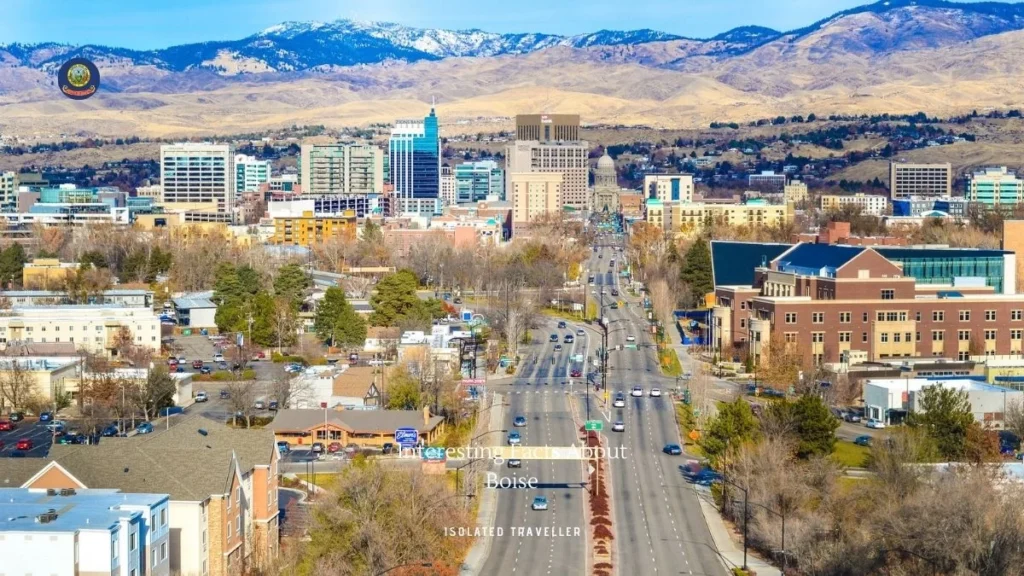
A short drive into the foothills brings you to Camel’s Back Park and the Hulls Gulch trail system. From the top of Camel’s Back you get a 360° view of the entire Boise valley, with the city laid out below, the river running through it, the patchwork of the agricultural Treasure Valley spreading west, and the Owyhee Mountains on the southern horizon. Sunset from up there is one of the best free experiences in the city.
Practical things worth knowing before you go
The best time to visit is May through October. Summers are hot and dry but not punishing (highs typically 85–95°F), and the long evenings are made for sitting outside. Winters bring snow but generally not enough to disrupt life. Spring and autumn are short but spectacular.
Getting there is easy. Boise Airport (BOI) has direct flights to most major western US hubs and a growing number of east coast cities. The city itself is laid out on a grid, and downtown is walkable. Renting a car is sensible if you plan to explore the foothills, wineries, or further afield.
For accommodation, downtown options range from boutique hotels (The Grove, Hotel 43, the historic Hotel Boise) through to standard chains. Rates are reasonable by US standards.
Why Boise deserves a closer look
Boise has spent most of its history being a place people moved to rather than visited. That’s slowly changing. The cocktail of cheap geothermal heat, river running through the centre, walkable downtown, Basque culture, mountain access, growing tech scene, only-Anne-Frank-memorial-in-the-country, blue football field, and properly good wine and food makes the city one of the more interesting American capitals you can visit right now.
It’s still small enough to feel like a real place rather than a polished tourist product. It’s still cheap enough to be enjoyable on a normal budget. And it’s still strange in the right ways — geothermally heated, French-named, Basque-flavoured, with a blue football field and a 1890s wooden water pipe that allegedly hasn’t rotted. Worth a few days of your time.
Frequently asked questions about Boise
Where is Boise located? Boise is in southwestern Idaho, in the Treasure Valley, about 350 miles east of Portland, Oregon and 340 miles north of Salt Lake City, Utah. It sits at the base of the Boise Foothills and along the Boise River.
How do you pronounce Boise? Locally, it’s pronounced “BOY-see” with a soft S, not “BOY-zee” with a Z. The mispronunciation is one of the easiest ways to spot a non-local.
What is Boise famous for? Boise is known for being the City of Trees, for hosting the largest Basque community in the US, for the blue football field at Boise State University, for being the only US state capital heated by geothermal energy, for the only Anne Frank memorial in the United States, and for its outdoor lifestyle and access to mountains, rivers, and trails.
Is Boise worth visiting? Yes. Boise is one of the most pleasantly surprising small cities in the American West — walkable, affordable, set in beautiful country, with a genuinely distinctive culture you won’t find anywhere else.
What is the best time to visit Boise? May through October offers the most consistently good weather. Summers are warm and dry, with long evenings ideal for sitting outside. Spring blossoms in the foothills are stunning, and autumn brings spectacular colour to the cottonwoods along the river.
Is Boise the potato capital of the world? No, despite popular belief. Idaho is the largest potato-producing state in the US, but the “potato capital” title belongs to other communities like Blackfoot, Idaho (home of the Idaho Potato Museum). Boise’s economy is much more diverse — tech (Micron), agriculture, government, and tourism all play a role.
How big is Boise? The city of Boise has a population of around 235,000, with the wider Boise metropolitan area home to roughly 800,000 people. It’s the largest city in Idaho and the largest city in a 700-mile stretch between Portland and Salt Lake City.
What is the City of Trees? “City of Trees” is Boise’s official nickname, dating from the French-Canadian fur trappers who reportedly named the area “Les Bois” (the woods) after seeing the cottonwoods along the Boise River. The city today has more than 100,000 trees within its limits.