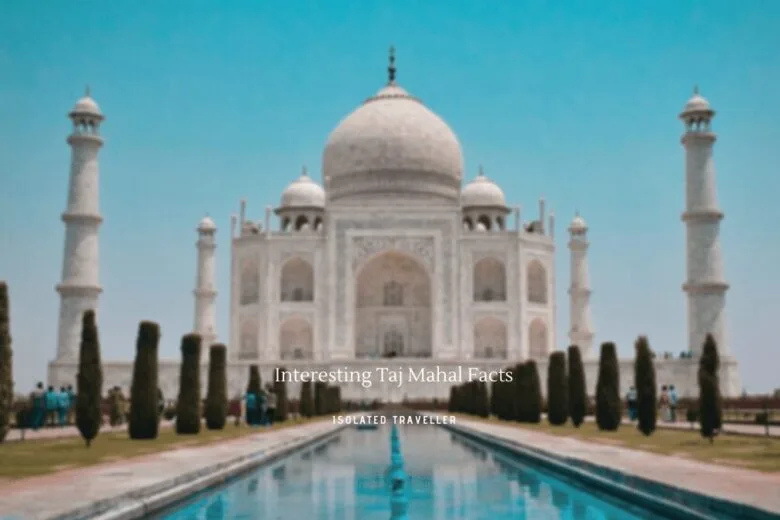
The Taj Mahal is an ivory-white marble mausoleum on the south bank of the Yamuna river, built by Mughal Emperor Shah Jahan as a tomb for his favourite wife Mumtaz Mahal who died in childbirth.
Setting & geography
Taj Mahal stands in Agra, India, at coordinates 27.18°, 78.04°. The surrounding landscape — urban, coastal, mountainous or rural — frames how the site is approached, photographed and understood. It draws pilgrims, scholars and the curious in roughly equal measure, and remains an active place of worship as well as a heritage site.
Architecture & form
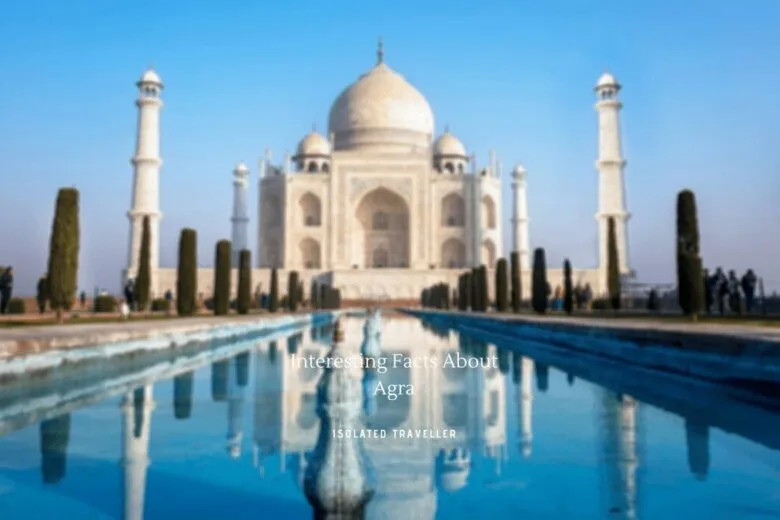
The Taj Mahal is a Mughal-era mausoleum complex, with the white marble tomb at its centre flanked by a mosque to the west and a guest house to the east, all set within a formal Persian-style charbagh garden divided by water channels into four quadrants. Symmetry governs almost every element of the design — even the calligraphy framing the main archway is subtly enlarged towards the top so it appears uniform when viewed from below.
The mausoleum itself is a massive square structure with chamfered corners, topped by a soaring onion-shaped central dome that rises about 73 metres from the platform. Four minarets at the corners of the platform are deliberately built leaning slightly outward, so that in the event of an earthquake they would fall away from the tomb rather than onto it. The white Makrana marble shifts colour through the day, reading pink at dawn, brilliant white at midday, and golden at sunset, with moonlit visits revealing yet another character.
The surface is decorated with pietra dura inlay — semi-precious stones including jasper, jade, lapis lazuli, turquoise, and carnelian set into the marble in intricate floral patterns. Quranic calligraphy by the master calligrapher Amanat Khan frames the great archways. Inside the mausoleum, the cenotaphs of Shah Jahan and Mumtaz Mahal sit within an octagonal chamber surrounded by a marble screen so finely carved it seems to be made of lace; the actual graves lie in a simpler crypt directly below.
Construction & history
The Taj Mahal was commissioned by the Mughal emperor Shah Jahan in 1632, the year after his beloved third wife, Arjumand Banu Begum — known as Mumtaz Mahal, 'jewel of the palace' — died giving birth to their fourteenth child. According to chroniclers of the period, the emperor's grief was so profound that his hair turned white within months. He resolved to build her a mausoleum that would have no equal anywhere in the world.
The principal architect is generally identified as Ustad Ahmad Lahauri, working with a council of designers from across the Islamic world — Persian, Indian, and Ottoman traditions all left their fingerprints on the final design. Construction took over twenty years and an enormous workforce. The white marble was quarried at Makrana in Rajasthan and transported by elephant; the inlay stones came from across Asia, including jade from China, turquoise from Tibet, and lapis lazuli from Afghanistan.
Shah Jahan was deposed and imprisoned by his son Aurangzeb in 1658, before the surrounding mausoleum complex was fully complete. He spent his last years confined in the Agra Fort, reportedly with a view of the Taj across the river, and was buried beside Mumtaz when he died in 1666 — the only asymmetric element in an otherwise perfectly symmetrical building. The Taj suffered neglect under the British Raj before Lord Curzon ordered its restoration around 1900. UNESCO designated it a World Heritage Site in 1983, and it now draws roughly six to eight million visitors a year.
Cultural significance
Taj Mahal appears on stamps, coins, school textbooks and a thousand photographs taken every day. It functions as a piece of national identity for India and as a piece of shared global heritage. UNESCO, national heritage agencies and local custodians typically have overlapping interests in the site’s protection — a useful tension that keeps the place both authentic and accessible.
Plan your visit
Most visitors reach Taj Mahal from Agra by public transport, organised tour or private taxi; check official sources for current opening hours, ticket prices and seasonal closures before you travel. Best light for photography typically falls in the early morning or the hour before sunset, when crowds also tend to thin. Modest dress and respectful behaviour are expected at religious or memorial sites; many landmarks restrict tripods, drones or large bags. Allow at least two hours on site and longer if you intend to visit any associated museums or grounds.
Specifications
Sort or filter the table to find the specifics quickly.
| Field | Value | Note |
|---|---|---|
| Country | India | — |
| Location | Agra | city / region |
| Type | Religious | landmark category |
| Built | 1632 – 1653 | period of construction |
| Architect | Ustad Ahmad Lahauri | — |
| Size | 73 m dome height | principal dimensions |
| Latitude | 27.1751 | degrees |
| Longitude | 78.0421 | degrees |
Did you know?
Construction of the Taj Mahal employed 20,000 workers and 1,000 elephants, and the marble was inlaid with 28 different types of precious and semi-precious stones.