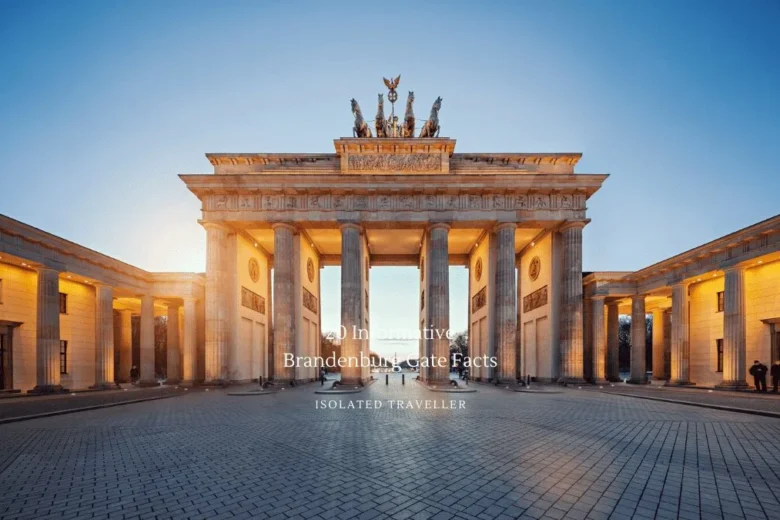
The Brandenburg Gate is an 18th-century neoclassical monument in Berlin, modelled on the Propylaea of the Athenian Acropolis. It became a symbol of German division during the Cold War and reunification afterwards.
Setting & geography
Brandenburg Gate stands in Berlin, Germany, at coordinates 52.52°, 13.38°. The surrounding landscape — urban, coastal, mountainous or rural — frames how the site is approached, photographed and understood. It marks a moment when the world's direction shifted — and the place still carries the weight of those events.
Architecture & form
The Brandenburg Gate is a neoclassical triumphal arch built in sandstone, with twelve Doric columns — six on each side — forming five passageways. Its design was directly inspired by the Propylaea, the monumental gateway to the Athenian Acropolis, and represents one of the earliest examples of Greek Revival architecture in Germany.
Atop the gate stands the Quadriga, a sculpture of the goddess of victory driving a four-horse chariot, designed by Johann Gottfried Schadow. The original quadriga faced east, into the city, marking the gate as a symbol of peace. The figure was given a wreath of oak leaves and the iron cross was added later, transforming her from a goddess of peace into one of victory.
The gate sits at the western end of Unter den Linden, the grand boulevard that historically ran from the gate to the Berlin City Palace, and forms the entrance to the Tiergarten park. Its proportions — symmetry, restraint, the careful spacing of the columns — were intended to evoke classical republican virtues at a moment when Prussia was redefining itself as a serious European power.
Construction & history
The gate was commissioned by King Frederick William II of Prussia and built between 1788 and 1791, replacing an earlier and far less imposing customs gate at the same point in the city wall. Carl Gotthard Langhans designed it as a monument to peace, reflecting the political ambitions of a Prussia that was beginning to see itself as more than a military state.
The gate's history since has been inseparable from Berlin's. Napoleon marched his troops through it in 1806 and took the Quadriga to Paris as war loot, where it remained until 1814. It served as the backdrop to Nazi torchlight parades in the 1930s, was heavily damaged during the Second World War, and ended the war battered but standing.
For most of the Cold War, the gate stood directly on the boundary between East and West Berlin, isolated in a no-man's-land made inaccessible by the Berlin Wall. It became one of the most photographed symbols of Germany's division. When the wall came down on 9 November 1989, crowds converged on the gate in scenes that came to define the end of the Cold War in popular imagination. It has since been restored and reopened as a pedestrian crossing, and serves once again as the symbolic centre of a reunified Berlin.
Cultural significance
Brandenburg Gate appears on stamps, coins, school textbooks and a thousand photographs taken every day. It functions as a piece of national identity for Germany and as a piece of shared global heritage. UNESCO, national heritage agencies and local custodians typically have overlapping interests in the site’s protection — a useful tension that keeps the place both authentic and accessible.
Plan your visit
Most visitors reach Brandenburg Gate from Berlin by public transport, organised tour or private taxi; check official sources for current opening hours, ticket prices and seasonal closures before you travel. Best light for photography typically falls in the early morning or the hour before sunset, when crowds also tend to thin. Modest dress and respectful behaviour are expected at religious or memorial sites; many landmarks restrict tripods, drones or large bags. Allow at least two hours on site and longer if you intend to visit any associated museums or grounds.
Specifications
Sort or filter the table to find the specifics quickly.
| Field | Value | Note |
|---|---|---|
| Country | Germany | — |
| Location | Berlin | city / region |
| Type | Historic | landmark category |
| Built | 1788 – 1791 | period of construction |
| Architect | Carl Gotthard Langhans | — |
| Size | 26 m tall | principal dimensions |
| Latitude | 52.5163 | degrees |
| Longitude | 13.3777 | degrees |
Did you know?
The Brandenburg Gate stood in the no-man's-land between East and West Berlin for nearly 30 years; Reagan's 1987 'Tear down this wall!' speech was delivered here.