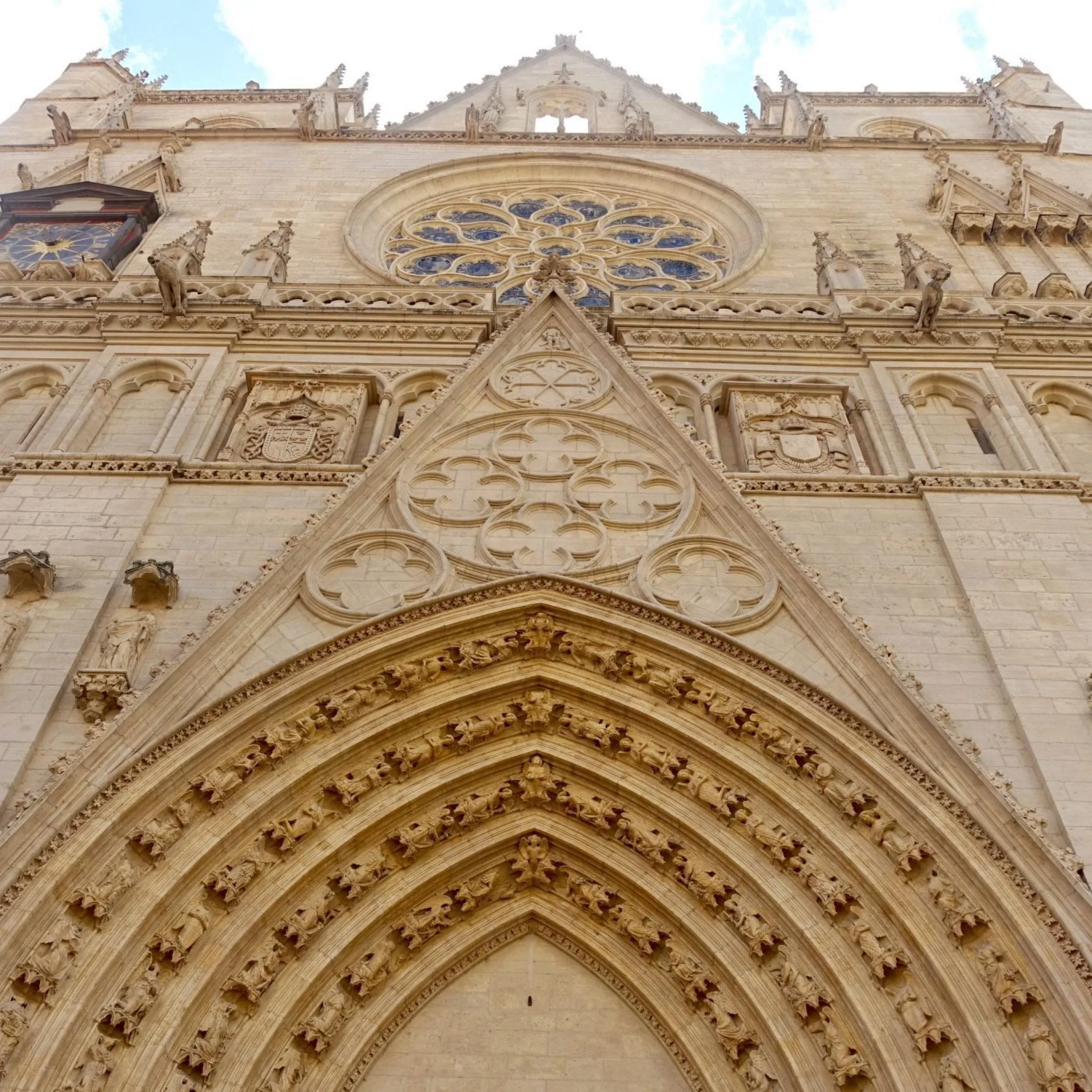
The Cathedral of St John the Baptist stands on the bank of the Saône in the heart of Old Lyon, beneath the hill of Fourvière. It is the seat of the Archbishop of Lyon, who bears the ancient title of Primate of the Gauls, the senior bishop of France. Begun in 1180 and finished three centuries later, it passes from Romanesque at the east end to full Gothic at the west, and it contains one of the oldest astronomical clocks in Europe. Entry is free. This guide covers its history, what to see, and how to visit.
Key facts at a glance
- Location: Place Saint-Jean, 69005 Lyon, France
- Built: 1180 to 1480
- Dedicated to: St John the Baptist and St Stephen
- Style: Romanesque apse; Gothic nave and facade
- Length: about 80 metres
- Famous for: its astronomical clock, of the 14th century and later
- Entry: free
History
The first Christians of Gaul
Lyon was the capital of Roman Gaul and the site of its first Christian community, whose bishop Pothinus was martyred in AD 177. His successor, St Irenaeus, was one of the great early theologians. The bishops of Lyon have claimed primacy over the Church in France since the 11th century.
Building the cathedral
Work began at the east end in about 1180, using stone taken from the Roman monuments on the hill above, and moved slowly westwards. The facade was completed in 1480. Beside the cathedral you can see the excavated foundations of the earlier churches and baptistery of the bishops’ complex.
Great events
Two general councils of the Church met here, in 1245 and 1274. Pope John XXII was crowned in the cathedral in 1316, and in 1600 King Henry IV married Marie de’ Medici here. The statues of the facade were smashed by Protestant troops in 1562 and again during the Revolution.
What to see
The facade
The three doorways are framed by some 300 small square carved panels of the early 14th century, showing scenes from the Bible, the signs of the zodiac, the labours of the months, and a lively bestiary of monsters.
The astronomical clock
In the north transept stands a clock nine metres tall. First mentioned in 1383 and rebuilt several times, it shows the date, the positions of the sun and moon, and the feast days of the Church, calculated far into the future. At set hours in the afternoon its figures move: a cock crows, angels play, and the Annunciation is enacted.
The stained glass
The windows of the apse and the rose windows of the transepts date from the 13th century; the great west rose was made in the 1390s.
The Bourbon Chapel
A masterpiece of flamboyant Gothic carving, built in the late 15th century by Cardinal Charles de Bourbon.
The treasury
Displays of liturgical objects, ivories, enamels and tapestries, in the old choir school beside the cathedral.
During the Festival of Lights
Each December, at the Fête des Lumières, the facade becomes one of the main canvases for the light shows that transform the city, and the square is packed.
Visiting
- Opening times: open daily, closing at midday on some days and during services.
- Entry: free; the treasury may charge.
- Getting there: Vieux Lyon – Cathédrale Saint-Jean metro station (line D) is two minutes away, and the funiculars to Fourvière leave from the same station.
Read our Lyon Cathedral facts for more detail. Nearby are the lanes of Vieux Lyon and, above, the Basilica of Fourvière. For more on the city, read our amazing facts about Lyon and see our photographs of Lyon.
Frequently asked questions
Is Lyon Cathedral free?
Yes.
How old is Lyon Cathedral?
It was built between 1180 and 1480.
What time does the astronomical clock in Lyon Cathedral chime?
At set hours in the afternoon; check the notice inside.
Is Lyon Cathedral the same as Fourvière?
No. The cathedral is in the old town; the Basilica of Fourvière is on the hill above.
Who is the Primate of the Gauls?
The Archbishop of Lyon.
Last updated: November 2026.