Key takeaways
- Interesting Facts About Preili: A Small Latvian Town With a Surprisingly Big Story
- Preili has been on the map since 1250
- The town was once more than half Jewish
- Preili Castle burned down for 37 years before anyone fixed it
- The manor park is bigger than you think
- There is a doll museum here, and it is unreasonably wonderful
Interesting Facts About Preili: A Small Latvian Town With a Surprisingly Big Story
If you’ve never heard of Preili, you’re not alone. Most travel guides give Latvia about three pages, and those three pages usually go to Riga, Jurmala, and maybe Sigulda if the editor is feeling adventurous. Preili sits roughly 200 km southeast of the capital, in a region called Latgale that even some Latvians describe as “the other Latvia.” It has a population of about 8,000, one of the oldest manor estates in the country, and a doll museum that should not be as good as it is.
This is a guide for anyone planning a trip, anyone already living there and looking for a fresh take on the place, and anyone who just stumbled on the name and got curious. The town is small. The list of interesting things about it is not.
Preili has been on the map since 1250
Most people are surprised to learn that Preili was first mentioned in written sources in 1250. That makes it older than most European capitals you can name off the top of your head. It only officially gained city rights in 1928, but it had already been a working settlement for nearly seven hundred years by then. So when locals describe it as a “quiet little town,” they’re slightly underselling it — quiet little towns don’t usually have a paper trail going back to the Middle Ages.
A note on pronunciation, because it trips people up: it’s roughly “PRAY-lee,” with the stress on the first syllable. The Latvian spelling is Preiļi, with that little hook under the L doing its own thing. Don’t worry too much about getting it perfect. Locals are forgiving.
The town was once more than half Jewish
This one tends to stop people. By 1935, the population of Preili was 1,662 — and just over half of those residents were Jewish. The town had a significant Jewish community for generations, with its own synagogue, schools, and a tight-knit business life centred around the marketplace.
That community was almost entirely wiped out during the Holocaust. There’s a memorial in Preili dedicated to the Jewish victims, and a Holocaust memorial site at Rušona forest just outside the town. It’s a sobering part of any visit, and one that doesn’t appear in glossy tourism brochures, but it’s a piece of Preili’s story that matters. If you go, take the time.
Preili Castle burned down for 37 years before anyone fixed it
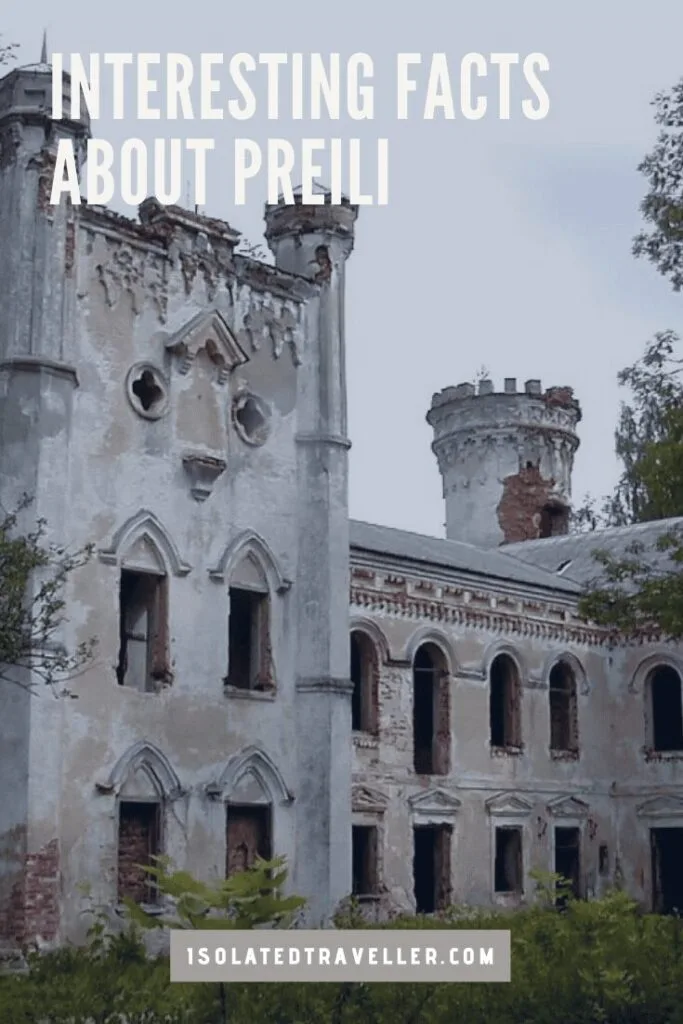
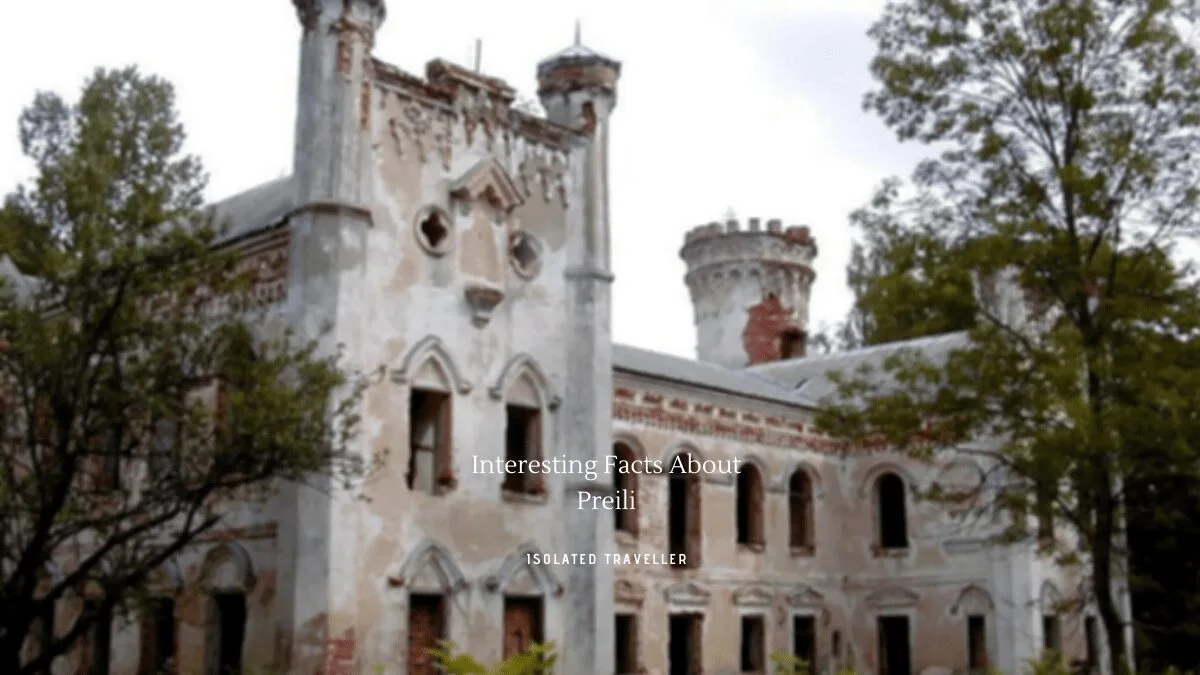
Here’s a fact that says a lot about post-Soviet Latvia: the gorgeous Neo-Gothic Preili Castle (sometimes called Preili Palace or Manor) caught fire in February 1978 and then sat as a blackened ruin for nearly four decades. The Borch family had built the original estate in the early 19th century, with the current Tudor-style English Neo-Gothic look added between 1860 and 1865.
After the fire, it just… stayed broken. Through the late Soviet years, through Latvia’s independence in 1991, through the early 2000s. It wasn’t until 2015 that the local government finally said enough was enough and started the rebuild. Partial restoration was completed in 2023, and the work won the “Latgale Tourism Award of the Year 2024.”
If you visit now, you can walk through restored rooms, climb the towers, and see what a Latvian aristocratic estate actually felt like. The chapel, stables, and the park’s main cottage are also open to look around.
The manor park is bigger than you think
The Preili landscape park covers 41.2 hectares, of which about 13 hectares are ponds. For context, that’s roughly 40 football pitches of formal grounds, ponds, walking paths, and old trees, all wrapped around the castle. It’s the kind of park where you can lose an afternoon without trying. Bring a flask, bring a book, bring someone you like talking to.
There’s also a small arboretum inside the grounds with mature trees from across Europe and beyond. Latvians love their parks (Riga has more green space per capita than most European capitals), and Preili’s manor park is one of the better-kept examples outside the big cities.
There is a doll museum here, and it is unreasonably wonderful
This is the fact I keep coming back to. Preili is home to the Preili Doll Gallery (sometimes called the Museum of Dolls or Mihaylovgrad), the single-handed creation of one artist, Jeļena Mihailova. She’s been making dolls since 1997 and has produced more than 1,000 of them.
What sets the place apart isn’t the volume, it’s the staging. Each doll lives in its own little scene with its own story. The museum opened to the public in 2008, and the backyard has been turned into a miniature kingdom with tiny castles, towers, bridges, and water mills. Visitors can dress up in princess and baroness costumes and take photos, which sounds gimmicky on paper but works better in practice — kids love it, adults pretend they’re indulging the kids and then end up enjoying it themselves.
The address is Daugavpils iela 21, if you’re plugging it into a map.
Preili sits in Latvia’s most Catholic and most multilingual region
Latgale is the only Catholic-majority region in a country that’s otherwise predominantly Lutheran. That’s because Latgale spent a couple of centuries (1561–1772) as part of the Polish-Lithuanian Commonwealth, and Catholicism took root in a way it didn’t elsewhere in Latvia. The famous Aglona Basilica, one of the most important Catholic pilgrimage sites in northern Europe, is about 30 minutes’ drive from Preili.
The region is also genuinely multilingual in a way Riga isn’t. You’ll hear Latvian, Russian, and Latgalian on the streets. Latgalian is technically classified as “a historical variant of Latvian,” but to most linguists it’s a distinct East Baltic language with about 164,500 daily speakers. UNESCO lists it as vulnerable. If you pick up “loba dīna” (good day) before you arrive, locals will absolutely notice.
The local drink is called Shmakovka, and yes, you should try it
Shmakovka is Latgale’s traditional moonshine — usually a grain or fruit-based spirit, sometimes infused with herbs or honey, traditionally produced on small farms. It’s been made in Latgale for centuries and is now produced legally by licensed local distilleries.
The biggest Shmakovka museum is actually in Daugavpils, about 50 km from Preili, but you can find the drink locally at markets and small shops. A tasting after a long walk in the manor park is, I am told reliably, one of the better small pleasures the region offers. The flavour can be polite or absolutely not, depending on the batch. That’s part of the fun.
Latgalian pottery is a recognised cultural treasure
Latgale produces the most distinctive ceramic work in Latvia, sometimes called Silajāņi ceramics after the parish where the tradition was strongest. These pieces are part of Latvia’s official Cultural Canon. The forms are bold, the glazes are dark and earthy, and a lot of the older designs have a pre-Christian feel to them, with animal and tree motifs.
In Preili itself, the Ceramics House of P. Čerņavskis offers an exhibition of regional pottery and live demonstrations of how the pieces are thrown and glazed. It’s a small workshop rather than a polished museum, which is exactly what makes it worth visiting.
There’s a metal-art gallery built out of motorbike parts
This is one of those “wait, what?” attractions. The Nester Custom Design gallery (also known as Nester Custom Moto & Metal Art Gallery) is tucked away in a Preili housing estate and started life as a workshop restoring crashed motorbikes and cars. Over the years, the owner started turning leftover engine parts and scrap metal into sculptures. The gallery now displays customised motorbikes alongside metal artworks made from gleaming pistons, gears, and exhaust components.
It’s the sort of place you’d never find in a polished tourism brochure, which is precisely why you should go.
You can fish, hike, or birdwatch your way through the surrounding lakes
The countryside around Preili is a patchwork of rolling hills, forests, and lakes. Lake Rāzna, the second-largest lake in Latvia, sits within easy driving distance and is a popular spot for fishing, kayaking, swimming, and just sitting still on a wooden jetty for an hour. The wider Latgale Lakeland is one of the most lake-dense parts of Europe — there are more than 100 lakes in the region.
For birdwatchers, the wetlands and forests host species you don’t easily see further west: black storks, white-tailed eagles, and a wide range of woodpeckers if you know where to look.
Practical things worth knowing before you go
The best time to visit is May through September. Winters in Latgale are properly cold (regularly -15°C or below), and while it’s beautiful under snow, half the outdoor attractions are closed or harder to reach. Summer brings long evenings, manor concerts, and folk festivals.
Getting there is easiest by car from Riga (about a 2.5-hour drive) or by intercity bus. There’s also a train line, though buses are usually quicker. Once you’re in town, Preili is small enough that you can walk between most of the main sights in a single morning.
For accommodation, you’ve got a handful of guesthouses, a couple of small hotels, and several manor-house stays in the wider area, including Ābeļi muiža (Apple Manor) and Arendole’s Manor, both of which run their own restaurants. A realistic daily budget for a comfortable independent traveller is around €40–€85 a day, which makes Preili one of the more affordable destinations in the EU.
Why Preili is worth a detour
Most people travel through Latgale on the way to somewhere else. They head for Daugavpils, or Aglona Basilica, or they cross into Lithuania. Preili rarely makes it onto an itinerary by itself, and that’s a shame, because the town does something most well-trodden destinations have lost — it lets you actually wander.
You can walk into the doll museum and have the artist’s assistant explain a costume to you. You can sit in the manor park with no one trying to sell you anything. You can hear three languages in a single coffee shop. You can eat properly good rye bread at a farmhouse a few minutes out of town and not see another tourist for an hour.
If that sounds like your kind of trip, put Preili on the list. The town has been quietly being itself for nearly 800 years. It’s not going to start performing for visitors now, which is exactly why you should go.
Frequently asked questions about Preili
Where is Preili located? Preili is in the Latgale region of southeastern Latvia, about 200 km from Riga and around 50 km from Daugavpils. It’s the administrative centre of Preiļi Municipality.
Is Preili worth visiting? Yes, especially if you’ve already seen Riga and want to experience a quieter, more culturally distinct part of Latvia. Highlights include the restored Preili Castle, the manor park, and the unique Preili Doll Gallery.
How do you pronounce Preili? Roughly “PRAY-lee,” with the stress on the first syllable. The Latvian spelling is Preiļi.
What is Preili famous for? Preili is best known for the Preili Manor and Castle, its 41-hectare landscape park, the Preili Doll Gallery created by artist Jeļena Mihailova, and its position as a cultural hub of the Latgale region.
What language do they speak in Preili? Latvian is the official language, but you’ll also commonly hear Russian and Latgalian, a regional language recognised as a “historical variant” of Latvian.
When is the best time to visit Preili? May through September. The weather is warm, the manor park is at its best, and most attractions, including outdoor sites and rural manors, are fully open.