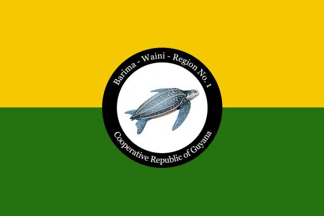
The flag of Barima-Waini is the flag of Region 1 of Guyana, one of the ten administrative regions of the country. It is a horizontal bicolour of yellow and green. The colours stand for the gold mining and forestry on which the region depends, and its emblem is the leatherback turtle that nests on its coast. This guide explains the design of the flag, what its colours and emblem mean, and the region it represents.

Key facts at a glance
- Region: Barima-Waini (Region 1), Guyana
- Design: a horizontal bicolour of yellow and green
- Emblem: a leatherback turtle, for Shell Beach
- Regional capital: Mabaruma
- Area: 20,339 square km
- Population: 26,941 (2012 census)
Design and colours of the flag
The flag is divided into two equal horizontal bands of yellow and green.
- Yellow (gold) represents gold and diamond mining.
- Green represents forestry and the forests that cover most of the region.
This is one of ten regional flags of Guyana. You can see them all in our list of flags representing the regions in Guyana.
The emblem
The version of the flag with an emblem shows a leatherback turtle. It represents Shell Beach, a stretch of about 140 km of remote Atlantic coastline where sea turtles come ashore to lay their eggs each year. The leatherback is the largest turtle in the world, and Shell Beach is the best-known nesting site in Guyana.
Where the colours come from
The colours of all ten regional flags are drawn from the Golden Arrowhead, the national flag of Guyana, adopted at independence in 1966. On the national flag green stands for agriculture and forests, white for rivers and water, gold for mineral wealth, black for endurance, and red for zeal and dynamism. The regional flags keep the same meanings and use the colours that best match each region.
History of the regional flags of Guyana
Guyana has ten administrative regions, created in 1980 and each run by an elected Regional Democratic Council. For most of their history the regions had no flags of their own. In 2017 the Ministry of Communities put forward a flag, an emblem and a set of colours for every region, published in a booklet titled “Emblems, Flags and Colours of the Regions of the Cooperative Republic of Guyana”. The aim was to give each region a stronger identity of its own.
Each flag exists in two versions: a plain bicolour or tricolour, and a version with the emblem of the region in the centre. The plan was debated at the time. Several regional chairmen and the then opposition party argued that the national flag, the Golden Arrowhead, should remain the only flag flown, so the regional flags are seen far less often than the national one.
About Barima-Waini
Barima-Waini is the north-western corner of Guyana, bordered by the Atlantic Ocean to the north and Venezuela to the west. It takes its name from its two main rivers, the Barima and the Waini.
- The region is mostly forested highland, with a narrow strip of low coastal plain along the Atlantic.
- It is one of the most thinly populated parts of the country, and most residents live in Amerindian communities.
- Logging and gold mining are the main economic activities.
- The main settlements are Mabaruma, Port Kaituma, Matthews Ridge and Moruca.
- Matthews Ridge was once a centre of manganese mining.
- Four species of sea turtle nest at Shell Beach: the leatherback, green, hawksbill and olive ridley.
- The scarlet ibis is a common sight along the coast.
Frequently asked questions
What does the flag of Barima-Waini look like?
It is a horizontal bicolour of yellow and green. A second version adds the emblem of the region in the centre.
What do the colours of the flag mean?
Yellow stands for gold and diamond mining, and green for forestry.
What is the capital of Barima-Waini?
The regional capital is Mabaruma, close to the border with Venezuela.
How many regions does Guyana have?
Guyana has ten administrative regions, numbered from 1 to 10 and named after the rivers that form their boundaries.
When were the regional flags of Guyana introduced?
The designs were put forward by the government of Guyana in 2017.
Last updated: November 2026.