The Museo Nacional del Prado in Madrid is one of the great art museums of the world. Its strength lies in the collections of the Spanish kings, who for three centuries bought and commissioned the best painters of Europe: it has the finest holdings anywhere of Velázquez, Goya, El Greco, Titian, Rubens and Hieronymus Bosch. “Las Meninas”, “The Third of May 1808” and “The Garden of Earthly Delights” all hang here. This guide covers the history of the museum, the paintings you should not miss, and how to plan a visit.
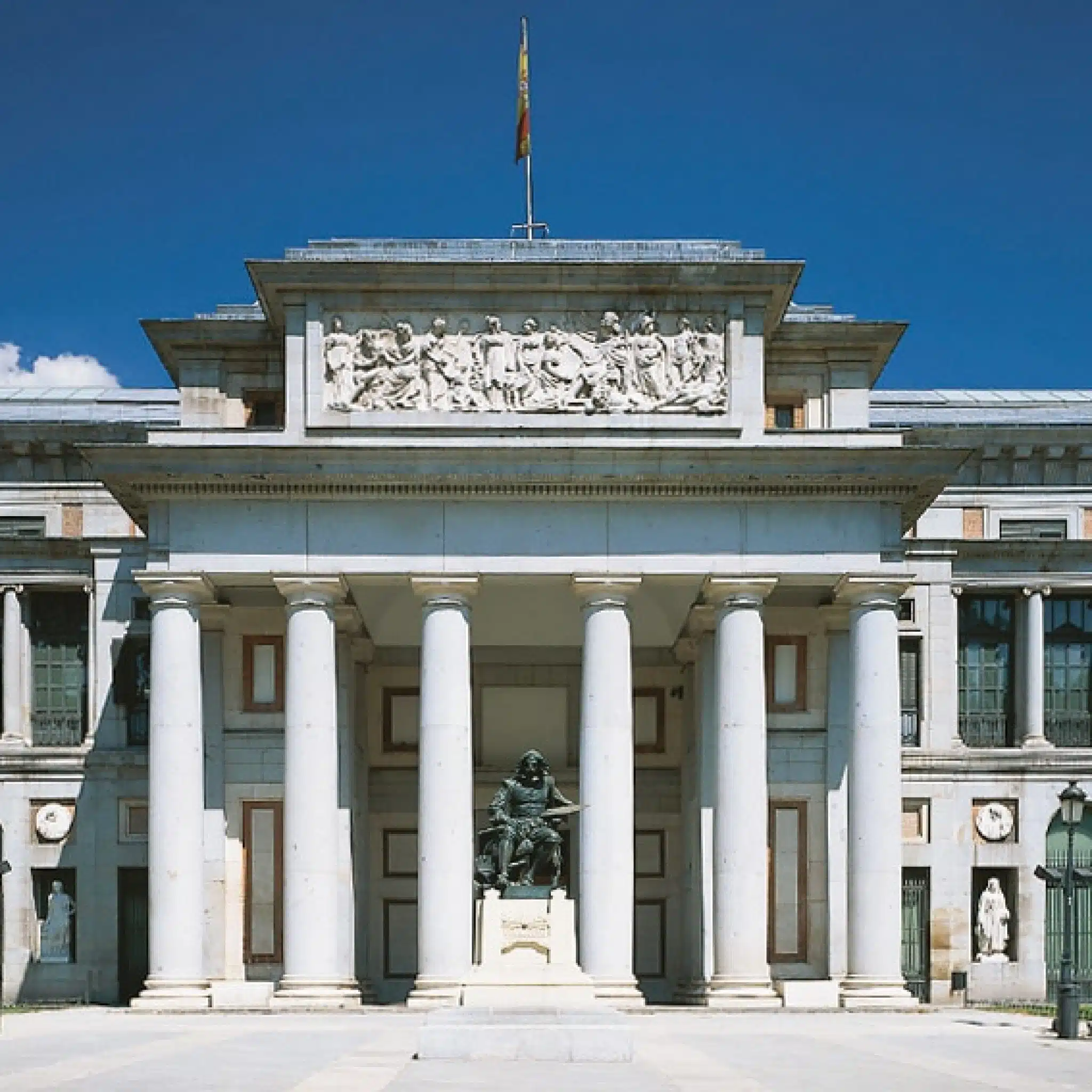
Key facts at a glance
- Location: Paseo del Prado, 28014 Madrid, Spain
- Opened: 19 November 1819
- Building: by Juan de Villanueva, begun in 1785
- Collection: about 8,000 paintings, of which some 1,700 are on show
- Open: daily
- Free entry: the last two hours of each day
- Time needed: three to four hours
History
A museum of science that became a museum of art
King Charles III commissioned the building in 1785 from the architect Juan de Villanueva as a cabinet of natural history, part of a scientific quarter on the “prado”, the meadow, on the edge of Madrid, along with the botanical garden and the observatory. Napoleon’s troops used it as a barracks. After the war, King Ferdinand VII, encouraged by his wife Maria Isabel of Braganza, decided to use it to display the royal paintings, and the Royal Museum opened in 1819 with 311 works.
Growth
The museum became national property in 1868 and absorbed the collections of suppressed monasteries. During the Civil War its treasures were evacuated to Valencia, Catalonia and finally Geneva. In 2007 an extension by Rafael Moneo was built around the restored cloister of the church of San Jerónimo. In 2021 the Paseo del Prado and the Retiro park were made a World Heritage Site.
Paintings you should not miss
Velázquez: Las Meninas
Painted in 1656, this enigmatic group portrait of the little Infanta Margarita, her maids, a dwarf, a dog and the painter himself at his easel is perhaps the most discussed picture in Western art. See also “The Surrender of Breda” and “The Spinners”.
Goya
The Prado owns well over a hundred paintings by Goya. They range from the sunlit tapestry designs of his youth, through the royal portraits and the two Majas, clothed and naked, to “The Third of May 1808”, his cry against the horror of war, and the nightmarish Black Paintings he made on the walls of his own house, including “Saturn Devouring His Son”.
Bosch: The Garden of Earthly Delights
Philip II was fascinated by Bosch, and the Prado has his greatest works. The triptych of the Garden, with its paradise, its crowded dream of pleasure and its musical hell, rewards long looking.
El Greco
The elongated figures and cold flames of colour of the Cretan who settled in Toledo: “The Nobleman with his Hand on his Chest” and the great altarpieces.
Titian and Rubens
The favourite painters of the Habsburgs: Titian’s equestrian portrait of Charles V at Mühlberg and his mythologies, and Rubens’s “Three Graces” and “Adoration of the Magi”.
Other treasures
Fra Angelico’s “Annunciation”, Rogier van der Weyden’s “Descent from the Cross”, Dürer’s self-portrait, Raphael’s “Cardinal”, Caravaggio’s “David and Goliath”, and the Spanish masters Ribera, Zurbarán and Murillo.
Tickets and tips
- Buy a timed ticket online to avoid the queue at the ticket office.
- Entry is free from 6 pm to 8 pm from Monday to Saturday and from 5 pm to 7 pm on Sundays and holidays, but the queue is long and two hours is not enough.
- The museum is closed on 1 January, 1 May and 25 December.
- The Paseo del Arte ticket covers the Prado, the Reina Sofía, home of Picasso’s “Guernica”, and the Thyssen-Bornemisza, all within ten minutes’ walk.
- Photography is not allowed in the galleries.
- Pick up a plan at the entrance; the masterpieces are marked, and most of the works named above are on the first floor.
- The nearest metro stations are Banco de España and Estación del Arte.
Elsewhere in Madrid, see our guides to the Royal Palace, the Temple of Debod and the Almudena Cathedral. For more on the city, read our amazing facts about Madrid.
Frequently asked questions
What is the most famous painting in the Prado?
“Las Meninas” by Velázquez.
Is the Prado free?
It is free during the last two hours of each day.
How long do you need at the Prado?
Three to four hours.
Is Guernica in the Prado?
No. It is in the Reina Sofía museum nearby.
Can you take photographs in the Prado?
No.
When did the Prado open?
On 19 November 1819.
Last updated: November 2026.