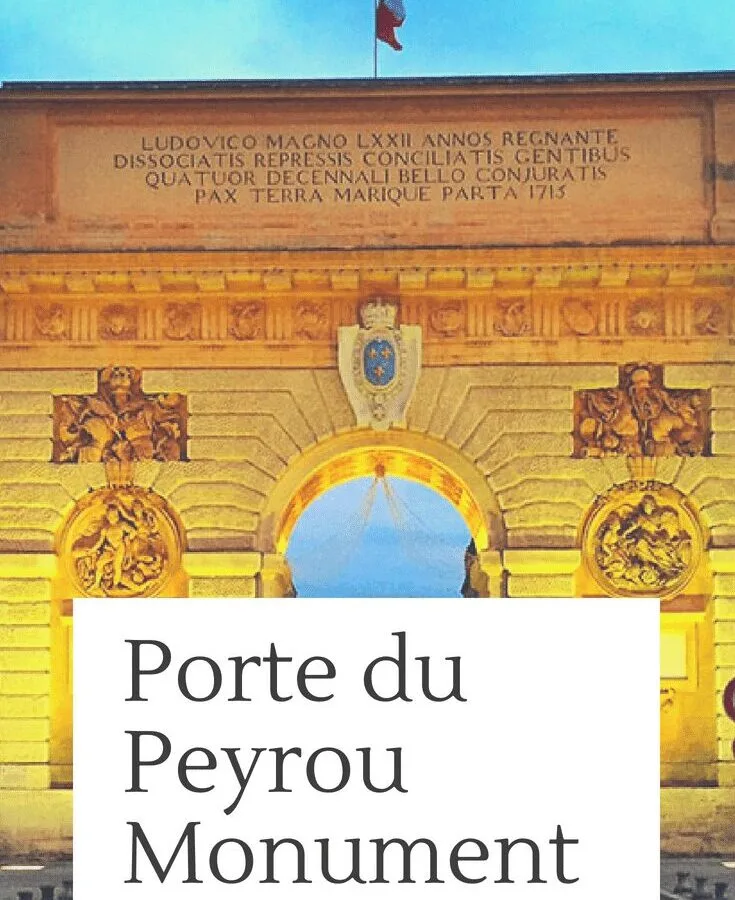
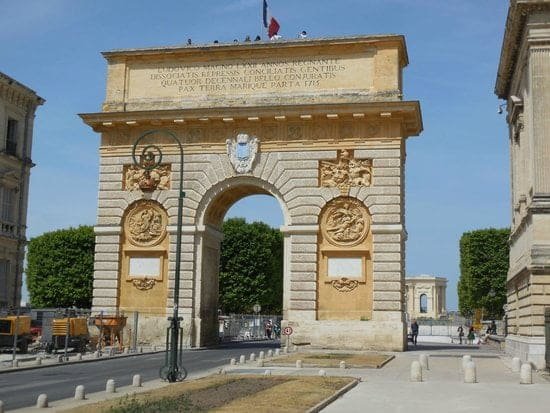
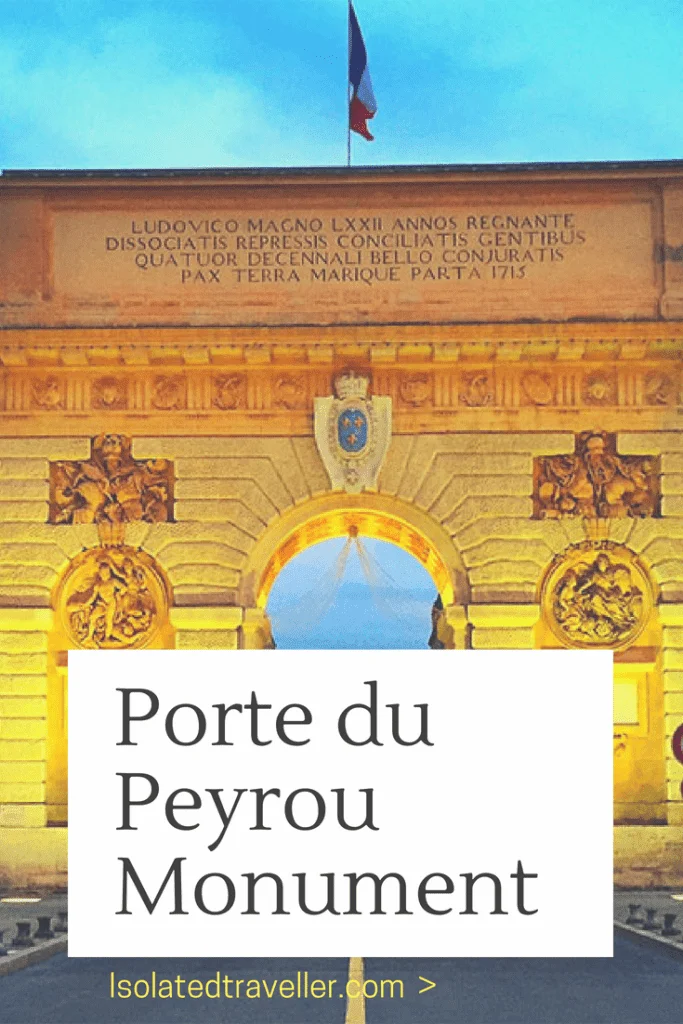
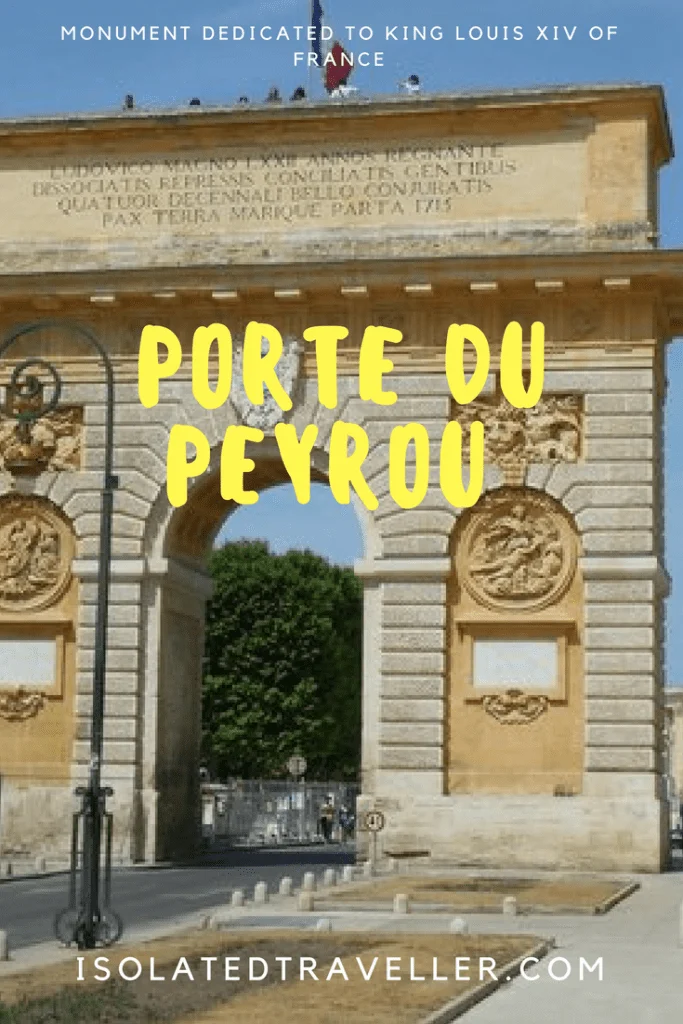
The Porte du Peyrou is the triumphal arch of Montpellier, built at the end of the 17th century to glorify Louis XIV, the Sun King. It stands at the highest point of the old town, at the end of the Rue Foch, and opens on to the Promenade du Peyrou, a royal esplanade with an equestrian statue, a temple-like water tower and an aqueduct striding away to the hills. Together they form the grandest piece of townscape in the south of France. This guide covers the history of the arch, what to see around it, and how to visit.
Key facts at a glance
- Location: Rue Foch, 34000 Montpellier, France
- Built: 1691 to 1693
- Designed by: François d’Orbay; built by Augustin-Charles d’Aviler
- Height: about 15 metres
- Reliefs added: 1715
- Leads to: the Promenade du Peyrou
- Visits to the top: on guided tours from the tourist office
History
A Protestant city humbled
Montpellier had been a stronghold of the Protestants, and was besieged and taken by Louis XIII in 1622. Under Louis XIV it became the administrative capital of the province of Languedoc, and the royal governor set about stamping the authority of the crown on the city.
The arch
The gate replaced a medieval gateway in the town walls. It was designed in Paris by François d’Orbay, on the model of the Porte Saint-Denis, and built in 1691 to 1693 by Augustin-Charles d’Aviler, of rusticated golden stone.
The reliefs
In 1715 four medallions were added. They celebrate the events of the reign: the building of the Canal du Midi, linking the Atlantic and the Mediterranean; the king’s victories over his enemies; the capture of Namur; and, most pointedly in this city, the revocation of the Edict of Nantes in 1685, which outlawed Protestant worship. A Latin inscription praises Louis the Great, whose reign lasted 72 years.
The Promenade du Peyrou
The royal square
The esplanade beyond the arch was laid out from 1689 on a rocky height, the “peyrou”, outside the walls. By decree, no building in the city was allowed to rise higher than its terraces, so that the view would remain open; on a clear day you can see the Cévennes, the sea and sometimes the Pyrenees.
The statue of Louis XIV
The first bronze statue of the king, set up in 1718, was destroyed in the Revolution. The present one dates from 1838.
The water tower
At the far end stands the Château d’Eau, an elegant hexagonal pavilion of Corinthian columns built in 1768 over the reservoir that received the city’s water supply.
The Saint-Clément aqueduct
Behind it arrives the aqueduct built between 1753 and 1765 by the engineer Henri Pitot. Inspired by the Pont du Gard, its double tier of arches, known locally as Les Arceaux, runs for some 800 metres and carried water 14 kilometres from the spring of Saint-Clément. A market is held beneath it on Tuesday and Saturday mornings.
Visiting
- The arch and the promenade are free and open every day; the gates of the promenade close at night.
- The top of the arch, reached by about 90 steps, can be visited only on guided tours of the historic centre run by the tourist office.
- The promenade hosts a flea market on Sunday mornings, and is a popular spot at sunset.
- The nearest tram stop is Peyrou – Arc de Triomphe (line 4); the Place de la Comédie is 15 minutes’ walk down the Rue Foch.
Read our Porte du Peyrou facts for more detail. Close by are the Jardin des Plantes and Montpellier Cathedral; further out is the Montpellier Zoological Park. For more on the city, read our interesting facts about Montpellier.
More photos of the Porte du Peyrou


Frequently asked questions
What is the Porte du Peyrou?
A triumphal arch in Montpellier built in honour of Louis XIV.
When was the Porte du Peyrou built?
Between 1691 and 1693.
Can you go up the Porte du Peyrou?
Yes, on guided tours organised by the tourist office.
What is behind the Porte du Peyrou?
The Promenade du Peyrou, with the statue of Louis XIV, the water tower and the aqueduct.
Last updated: November 2026.